
May 2, 2026
Sparks Media Group 732 Nissan Drive Smyrna, Tn, 37167 USA
Politics

Upholding the Constitution: SCOTUS Ends Racial Quotas and Clears Path for GOP Redistricting Wins”

Editor’s Note
This article reflects the immediate legal and political fallout following the U.S. Supreme Court’s April 29, 2026, decision in Louisiana v. Callais. The ruling overturned a previous map that included two majority-Black districts, marking a significant shift in how federal courts interpret the Voting Rights Act (VRA). This report has been updated to include responses from state officials grappling with the new legal standard.

Summary of the Ruling
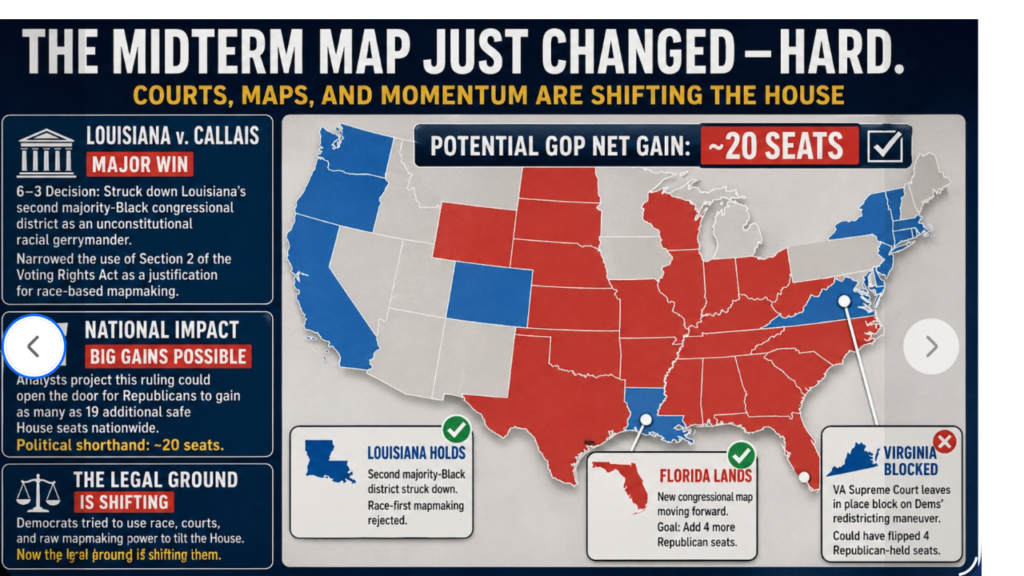
In a 6-3 decision, the Supreme Court ruled that Louisiana’s 2024 congressional map—which had been drawn to include a second majority-Black district—constituted an “unconstitutional racial gerrymander.”  
Writing for the majority, Justice Samuel Alito argued that the state gave “undue weight” to race, violating the 14th Amendment’s Equal Protection Clause. Crucially, the ruling changes the “test” for future lawsuits: whereas voters previously only had to prove that a map had a discriminatory effect, they must now provide evidence of discriminatory intent.  
In her dissent, Justice Elena Kagan warned that the decision “threatens a half-century’s worth of gains in voting equality” by making it nearly impossible for minority groups to challenge maps that dilute their political power.  
The Ruling in Simple Terms
What was the fight about?
Louisiana has six seats in the U.S. House of Representatives. About one-third of the state’s population is Black. For a long time, only one of those six districts was “majority-Black” (meaning Black voters were the majority and could easily elect their preferred candidate). Civil rights groups argued there should be two districts to fairly reflect the population.  
What did the Court decide?
The Court said that by specifically trying to create that second Black district, the state focused too much on race. Even though the state was trying to follow the Voting Rights Act, the Court ruled that “sorting” people into districts based on their race is generally illegal under the Constitution unless there is an extraordinary reason for it.  
Why does this matter?
1. Harder to sue: In the past, if a map resulted in unfairness toward a minority group, that was often enough to get it changed. Now, you have to prove the people who drew the map intended to be biased—which is much harder to prove “on paper.”  
2. Redrawing the lines: States like Louisiana must now go back to the drawing board. This will likely result in fewer districts where minority voters are the majority, which often leads to fewer minority representatives being elected to Congress.  
3. National impact: Other states (like Alabama and Mississippi) are now using this “Louisiana rule” to justify changing their own maps to favor majority parties or reduce race-based districts.
____________________________________________________________________
The U.S. Supreme Court has issued a landmark ruling striking down a majority-Black congressional district in Louisiana. The decision significantly narrows the role race can play in redistricting, effectively weakening key provisions of the Civil Rights-era Voting Rights Act.
Even before the formal opinion was released, several states—anticipating a shift in the legal landscape—had already begun positioning themselves to redraw their electoral maps.
Southeastern States Pivot Quickly
Florida
In a swift response, Florida’s Republican-controlled Legislature approved a new U.S. House map just hours after the ruling. This new configuration is projected to help the GOP secure up to four additional seats this November.
• The Catalyst: Governor Ron DeSantis called a special session in anticipation of the ruling. He argued that the 14th Amendment prohibits the government from “divvying up the citizenry” by race.
• The Conflict: While a 2010 Florida constitutional amendment protects the voting power of minorities, DeSantis maintains that such protections may conflict with the U.S. Constitution.
Mississippi
Governor Tate Reeves has scheduled a special legislative session to begin in three weeks to redraw the state’s Supreme Court districts.
• Background: A federal judge previously found that Mississippi’s current judicial maps diluted the power of Black voters.
• The Goal: Lawmakers plan to use the new Supreme Court guidance to determine if “race-conscious redistricting” remains constitutionally viable.
Legislative Uncertainty and Logistical Hurdles
Louisiana
The state at the center of the case faces a tight timeline. While lawmakers previously moved primary dates to May 16 to accommodate the ruling, early voting begins this Saturday. State leaders are currently reviewing the decision to see if maps can be legally altered before the general election.
Alabama
Despite a 2023 court order that created a second near-majority Black district, state officials are looking to the new ruling to reverse course.
• The Stance: Attorney General Steve Marshall praised the decision, labeling the current map a “racial quota system.”
• The Reality: With primaries set for May 19, Governor Kay Ivey noted that a special session is not currently feasible.
Tennessee
The ruling has sparked calls for a late-stage overhaul of Tennessee’s maps.
• The Proposal: U.S. Senator Marsha Blackburn urged the legislature to redraw the Memphis-based Democratic district to favor Republicans.
• The Obstacle: Senate Speaker Randy McNally pointed out that because the candidate qualifying period has already passed, redistricting now would cause significant “logistical challenges.”
Democratic Response: Illinois
In a preemptive move to counter the Supreme Court’s direction, the Illinois House approved a state constitutional amendment to codify protections for race-based redistricting.
However, the state Senate has opted for a more cautious approach. Senate President Don Harmon stated that they will delay a vote to allow legal experts to analyze the Supreme Court’s ruling, citing the high stakes involved in protecting minority representation.

Leave feedback about this

  • Quality
  • Price
  • Service

PROS

+
Add Field

CONS

+
Add Field
Choose Image
Choose Video
X