October 7, 2026
Sparks Media of Tennessee 732 Nissan Drive Smyrna, Tn, 37167 USA
1st Amendment/Free Expression

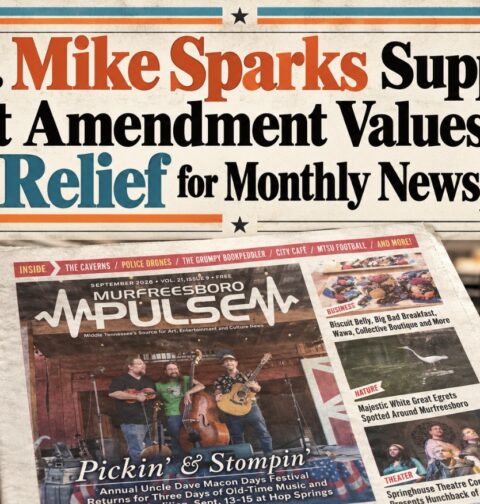
I’ve long believed that a free press is essential to a free people. The First Amendment protects freedom of the press for a reason: citizens need access to information, differing viewpoints and local voices—especially when it comes to decisions being made in their own communities. As a small-business owner, publisher and state legislator, I also understand that small newspapers operate on tight margins. They don’t have the resources of large media corporations or teams of lobbyists walking the halls of government. Sometimes they simply need someone willing to listen. That was the spirit behind Bracken’s Law. When Bracken mentioned to me that monthly newspapers were being treated differently under Tennessee’s tax law than newspapers published more frequently, it seemed like a matter of basic fairness. If a newspaper serves its community once a month rather than twice a month, why should it be placed at a tax disadvantage? Bracken’s Law helped level that playing field. This issue is also deeply personal to me. My experiences in public service were part of what motivated me to return to college and study communications more deeply. I’ve seen firsthand the tremendous value of responsible local journalism—but I’ve also experienced what I believe were examples of inaccurate reporting, political propaganda and, just as importantly, stories that were never told. At times, I watched political opponents push narratives about me that I believed were false or misleading, only to see versions of those claims appear in local media. One experience particularly stayed with me. An MTSU television news professor, after observing some of the coverage, told me in class, “Mike, I’ve never seen anyone attacked by the media like you are being attacked. That’s highly unethical.” I responded, “Now you understand why I went back to school to study communications.” Another incident reinforced that lesson. Six individuals I understood to be associated with Antifa showed up outside our home around 4 a.m., yelling through a bullhorn and beating a drum. Police responded, neighbors were awakened, and my family was frightened. Yet despite the extraordinary nature of the incident, I saw little or no local news coverage of it. That experience taught me something important: media influence isn’t limited to what gets reported. What doesn’t get reported can shape public understanding, too. I sometimes call that “censorship by omission.” A free press has every right to determine what it considers newsworthy, but readers also have every right to ask why certain stories receive extensive attention while others receive virtually none. Those experiences did not make me an opponent of journalism. Quite the opposite. They strengthened my belief that we need more independent voices, more local newspapers and more competition in the marketplace of ideas—not fewer. That is one reason Bracken’s Law means so much to me. A healthy First Amendment depends on people willing to report, question, investigate and sometimes challenge the prevailing narrative. Whether we agree with a newspaper or not, Tennessee benefits when hometown publications have a fair opportunity to survive and serve their communities. Government shouldn’t decide which voices are important based on how frequently they go to press. Whether it’s a large daily newspaper or a small hometown publication produced by a handful of dedicated people, a healthy free press strengthens our communities and our republic. That’s why I was proud to sponsor Bracken’s Law—and why I hope Tennesseans will continue supporting the hometown newspapers that work every day to keep their communities informed. __________________________________________________________________ Bracken’s Law: Tax Relief for Tennessee’s Monthly Newspapers A change in Tennessee law brought monthly newspapers the same production tax exemption already available to more frequent publications such as the Tennessean newspaper. Local newspapers help communities keep up with the people, decisions and events that shape daily life. Yet many small publications face tight budgets and limited staff—and the loss of a newspaper can leave a community with fewer ways to follow local affairs. A 2018 report from the University of North Carolina’s Center for Innovation and Sustainability in Local Media found that the country had lost nearly 1,800 local newspapers since 2004. More than 500 rural newspapers had closed or merged, while many surviving papers had reduced their ability to cover their communities. Rural areas can be especially difficult for digital startups to serve.  Tennessee took a step to support smaller publications in 2019 with House Bill 899, known as Bracken’s Law. Sponsored by Rep. Mike Sparks, with Sen. Bo Watson carrying the Senate companion bill, the measure expanded a state sales-tax exemption for certain periodicals printed on newsprint or bond paper. Before the change, the exemption applied to qualifying publications distributed at least twice a month. Bracken’s Law extended it to publications issued at least monthly, giving monthly newspapers the same treatment. Gov. Bill Lee signed the bill on May 24, 2019, and it took effect July 1, 2019.  For a small, family-owned newspaper, every production cost matters. The change addressed a tax difference that had affected monthly publications when they paid to print each edition. It also recognized the value of local outlets that serve their readers on a monthly schedule. “A big thank-you to Rep. Mike Sparks, Sen. Bo Watson, Gov. Bill Lee, and the Tennessee General Assembly for supporting small businesses and free expression through Bracken’s Law,” said Bracken Mayo, publisher of the Murfreesboro Pulse. The law is one way to help monthly publications, but strong local journalism also depends on readers and communities. Support local newspapers by subscribing, sharing their reporting and encouraging local businesses to advertise. If you want to see lawmakers continue supporting community publications, contact your state legislators and tell them why local newspapers matter to you. Small “mom-and-pop” newspapers often cannot afford to hire lobbyists. Community members can help make sure their voices—and the needs of the places they serve—are heard.

X