Sparks Media of Tennessee 732 Nissan Drive Smyrna, Tn, 37167 USA
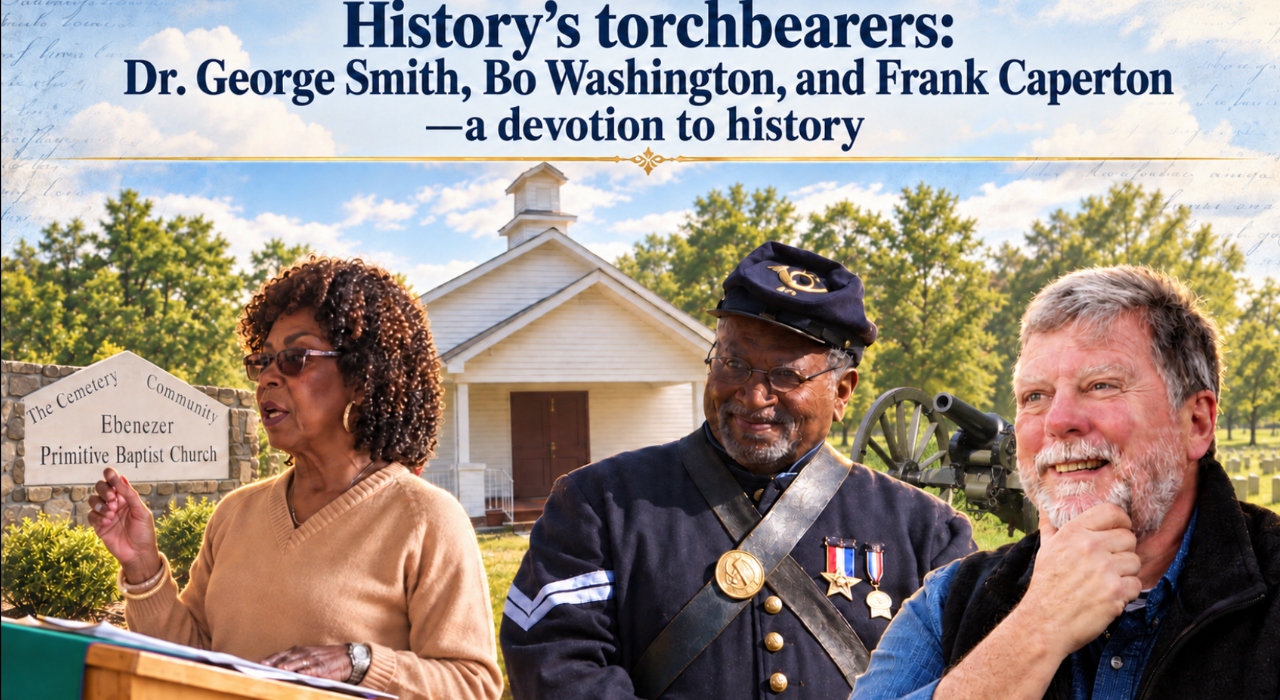
Sparks Media of TennesseeFaithHistory’s torchbearers: Dr. George Smith, Bo Washington, and Frank Caperton—a shared devotion to history and the next generation
Dr. George Smith, Bo Washington, and Frank Caperton: A shared devotion to history and the next generation
This morning, Pastor Jerry Weeden invited me to say a few words at Ebenezer Primitive Baptist Church. The historic, 165-year-old church reminds me of the little country church from the television show Little House on the Prairie.
The church once stood on land that became part of the Stones River National Battlefield. Rather than allow the building to be destroyed, members of the community moved it to its present location by rolling it across cedar logs with the help of mules. Needless to say, there is some remarkable history within those old walls.
Pastor Weeden’s message was titled “Cast Your Cares.” He reminded us of the comforting words of 1 Peter 5:7: “Cast all your anxiety on him because he cares for you.”
He also shared one of my favorite passages, Proverbs 3:5–7:
“Trust in the Lord with all your heart
and lean not on your own understanding;
in all your ways submit to him,
and he will make your paths straight.
Do not be wise in your own eyes;
fear the Lord and shun evil.”
Those Scriptures seemed especially appropriate in a church that has survived for generations through faith, sacrifice and the determination of people who refused to let an important part of their heritage disappear.
The philosopher George Santayana famously warned, “Those who cannot remember the past are condemned to repeat it.” Dr. George Smith understood that truth. He knew our history, and he did not want future generations to forget either its painful lessons or its inspiring stories.
Dr. Smith loved Tennessee history and possessed a special gift for telling the stories of those who came before us. More importantly, he loved his fellow man. He was one of the kindest gentlemen I have ever known, with what I can only describe as a “Christlike coolness” about him. He carried himself with dignity, humility and a quiet strength that put people at ease.
I first came to appreciate that spirit more deeply after my efforts in the Tennessee General Assembly to recognize “Tennessee’s Rich History.” The resolution created controversy because it mentioned two very different figures from our past: Sampson W. Keeble and Confederate General Nathan Bedford Forrest.
Keeble, who was born to enslaved parents in Rutherford County, became the first African American elected to the Tennessee General Assembly in 1872 and served as a Republican. While serving in the House, he introduced legislation seeking to protect Black laborers and their wages and to expand economic opportunity. His story deserves to be known by every Tennessean. The Tennessee Encyclopedia documents Keeble’s life and legislative service.
The resolution also referenced Forrest and the speech he delivered in Memphis in 1875 to the Independent Order of Pole-Bearers, an early Black civic organization. Forrest’s life remains one of the most controversial and painful chapters in Tennessee history. His involvement in slavery, the Confederacy and the Ku Klux Klan cannot be ignored. Neither should historians ignore his later public words calling for reconciliation. Studying history honestly requires us to confront the complete record—not to conceal its darkest chapters or simplify its most complicated people.
Having been born and raised in Smyrna, I was never taught the story of Sampson Keeble. I also had never heard about Forrest’s 1875 address. When I began reading about these events, I became deeply interested in why such important and complicated stories were largely absent from what many of us learned.
My thought was simple: Perhaps our society would be better if our communities—Black and white—understood more of our shared history and were willing to discuss it honestly.
Nobody know the Cemetery Community story better than Leonora “Boe” Washington. Frank Caperton of the Friends of the Stones River National Battlefield captured this video of Bo during our February 6th tours
Around that time, Frank Caperton, president of the African American Heritage Society of Rutherford County, invited me to an event at Ebenezer Primitive Baptist Church. I was already scheduled to attend an MTSU graduation where Randy Boyd was delivering the commencement address, but I chose instead to attend the heritage event.
Looking back, I believe that invitation was a “God-wink” moment.
When I arrived, the group walked together to a newly completed fieldstone sign. Other than then-Mayor Ernest Burgess and Frank, I was one of only a few white people attending. As we walked, we sang several hymns and concluded with one of my favorites, “Amazing Grace.”
After the hymn, Dr. Smith offered a few words. He then looked toward me with his kind smile and said, “Rep. Mike Sparks, will you say a few words?”
I was pleasantly surprised. I had wondered whether some in attendance might believe the negative characterization surrounding my legislative effort. Instead, Dr. Smith extended grace and gave me an opportunity to speak.
I told the crowd that history belongs to all of us. I noted that “Amazing Grace” was written by John Newton, a former slave-ship captain whose Christian conversion eventually led him to support the abolition of the slave trade. Newton became an important spiritual influence on British lawmaker William Wilberforce, who devoted much of his life to ending Britain’s participation in that evil institution.
Newton’s was a story of sin, repentance, redemption and service. It reminded me that God can transform lives and use imperfect people to accomplish good.
Later that day, Mary Watkins, then president of the Heritage Society, thanked me for helping bring attention to Sampson Keeble. She said that perhaps if more young people understood their history, we would not face some of the problems confronting society today. Her words have stayed with me.
Our county has now lost three remarkable guardians of local history: Dr. George Smith, Frank Caperton and Bo Washington.
Dr. Smith broke barriers as the first African American physician granted privileges at the former Rutherford County Hospital. Yet his legacy reaches far beyond medicine. He was a healer in the broadest sense—a man who built relationships, preserved history and brought people together with kindness.
Frank Caperton understood the importance of an invitation. One phone call from Frank brought me to Ebenezer, introduced me more fully to the Cemetery community and began a partnership that helped produce lasting results.
Bo Washington, a beloved longtime Smyrna teacher, carried history to generations of young people. I once attended an African American Heritage Society event and announced from the audience that Ms. Washington had been a teacher at Smyrna Primary when I was six years old. Without missing a beat, she responded, “Sparks, I will get you back for that!”
That was Bo—sharp, spirited and unforgettable.
It is both sad and surreal to see these three community leaders pass away. Yet their work continues. My successful legislative budget request for $250,000 to support the historic Cemetery community would not have come to fruition without the groundwork, encouragement and persistence of Dr. Smith, Frank Caperton and Bo Washington.
They understood that preserving history is not merely about protecting old buildings, markers, photographs or documents. It is about protecting the memories of people whose sacrifices helped build our community. It is about making certain that young people know where they came from so they can better understand where they are going.
Today, Ebenezer Primitive Baptist Church still stands because earlier generations decided it was worth saving. They purchased the lot where the church now sits for $100. They placed it on cedar logs, hitched up the mules and moved it to safety. In their own time and in their own ways, Dr. George Smith, Bo Washington and Frank Caperton did something similar: They carried our history forward so it would not be lost.
They were history’s torchbearers. Now that torch is passed to others.
Frank called me mere hours before Dr. George Smith passed away. He said, “Mike, Dr. Smith’s cancer has returned and he doesn’t have much longer to live.” I was in the middle of a legislative session. I got Speaker Cameron Sexton’s attention and was able to pay tribute to Dr. Smith on the House floor. He passed just a few hours later.
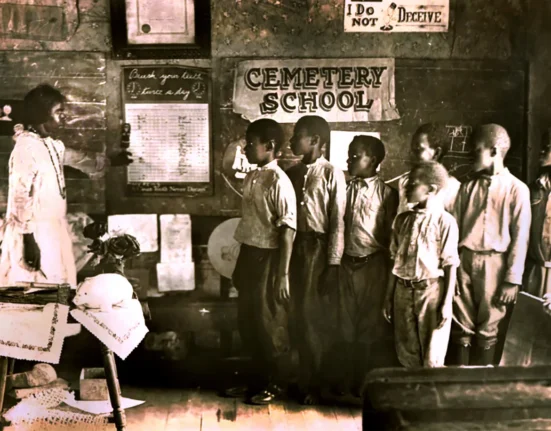
Many thanks to Speaker Sexton for his efforts to help secure the $250,000 grant for the Cemetery Community’s restoration of the old Cemetery School, along with Rep. Harold Love Jr., Rep. Jesse Chism, and Rep. Yusuf Hakkin.
May we honor them by continuing to tell the whole story, by listening to one another with humility and by teaching the next generation that history is not something dead and buried. It lives in our churches, our cemeteries, our neighborhoods and our families.
Our community has lost three compassionate and devoted leaders, but their influence remains. I pray that young people will look to their lives as examples of service, courage, faith and love for their fellow man.
Dr. Smith, Ms. Washington and Frank Caperton left Rutherford County better than they found it. That is a legacy worth remembering—and worth carrying forward.


Leave feedback about this