

Editor’s Note: Rethinking New Year’s Resolutions
It’s that time of year again—yes, New Year’s resolutions! I have several this year, and thinking about my own goals got me wondering whether we’re approaching resolutions the right way.
My 2026 Goals:
• Lower my blood pressure through better eating and more cardio (200 minutes weekly per Dr. Adam Allie’s recommendation)
• Keep up daily workouts, but smarter—reduced sets on strength training to prioritize heart health (I’m told my 330 pound bench press days are over)
• Hit 50 exercise dips (I’m at 33 now)
• Be more forgiving and thoughtful of others
• Become a better listener, husband, father, and grandfather
• Take marketing and communication classes at MTSU to improve my writing
• Pass meaningful legislation that lifts up Tennesseans rather than burdening them with unnecessary laws (Did You Know? There are NO lobbyist for the common man—Just Sayin’)
* Learn To Do More with Less
* Write an additional book this year
*Be content with what I have (I’n not trying to keep up with the Thomases, Dempseys, Brewers, Lewises, Luffmans and yes, the Jones.)
At 58, I’ve learned to adjust my approach and shift my paradigm. Trying to match Titan football player Eddie George, I once set a goal at 33 to bench press 225 pounds for 24 reps and got 23. Now, I focus on staying healthy, because your body does not bounce back the same way as you get older.
…By the way. I’ve got a few FREE 7 Day passes to Crunch Fitness. Email me f you want one MikeSparksTn@gmail.com. I visit the one in M’Boro and Antioch.
The History
New Year’s resolutions go back over 4,000 years to ancient Babylon, where people made promises to their gods—mostly to return borrowed items and pay debts. The Romans continued the tradition when Julius Caesar reformed the calendar in 46 B.C., making pledges to Janus (January’s namesake).
The problem? We’re terrible at keeping them. Less than 10% of people maintain their resolutions all year, with most abandoning them by February. Why? Resolutions are often too vague and overly ambitious. “Get healthy” sounds great, but what does that actually mean?
Goals vs. Resolutions
I’ve never been big on resolutions—they fade quickly. Goals are different. They stick with you and are easier to measure. That’s where SMART goals help: Specific, Measurable, Achievable, Relevant, and Time-bound. Instead of “exercise more,” try “attend three 30-minute fitness classes weekly for three months.” You’ll know exactly what you’re doing and can track your progress.
The bigger question: Do we even need January 1st to make changes? Setting goals when you’re actually ready, with a real plan and realistic expectations, works better than making pronouncements because everyone else is. Whether you prefer resolutions or year-round goal-setting, what matters is finding what works for you.
____________________________________________________________________
Seven ideas for more happiness together in the new year
KEY POINTS
-
Making a commitment to positive relationship change can get you off to a great start in the new year.
-
Making the decision to be fully present and to listen to your partner is a good first step.
-
Collaboration rather than blaming or making excuses can help bring positive change.
-
And feeling gratitude for what brought you together and keeps you close can make a major difference.
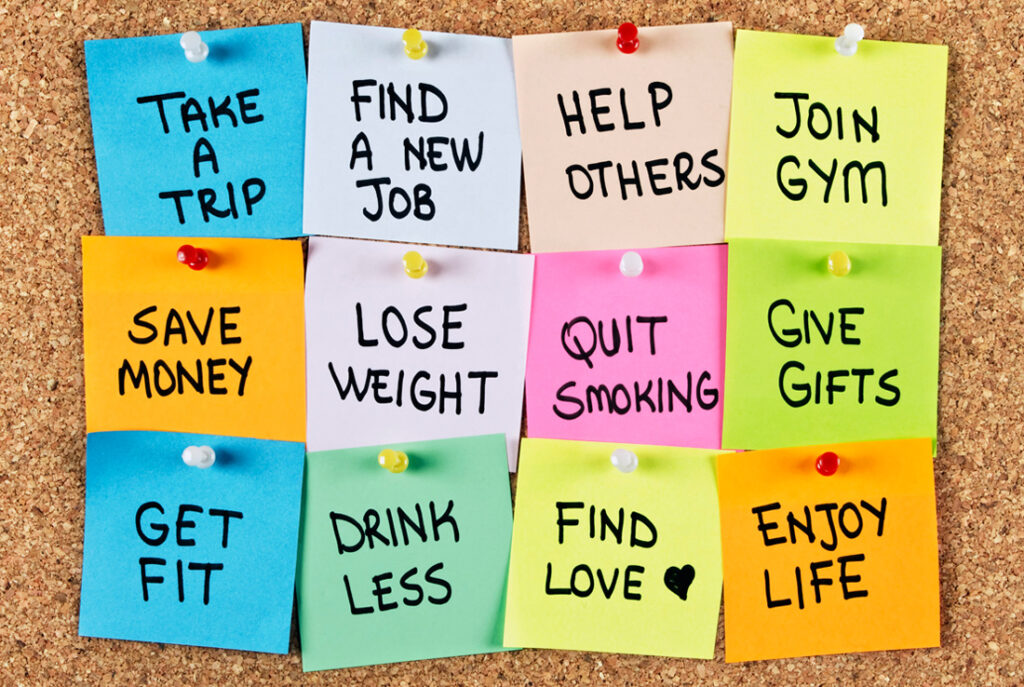
As time goes by, it’s common to get a bit cynical about New Year’s resolutions.
“I never keep them, so why make any,” my friend Cynthia observed with a shrug as we talked about our hopes that life could be different in the coming year.
I agreed that most of the promises to exercise daily, eat Mediterranean or low-carb or keto, and to stick to a strict budget all tend to crash and burn before January is over. But what if one entertained ideas for life renewals and changes in the year to come? And what if these ideas centered on bringing more positivity to an important relationship?
What might be possible if you told yourself:
Just for today (and maybe all year) I’ll banish my phone from meals — both at home and at restaurants — and really see and hear my partner. It has become less shocking but still sad to see couples out for a date night at a restaurant that is spent largely on their phones. Facing each other over a shared meal, whether at home or out, and seizing the opportunity to reconnect can be a joy. If most of your meals are spent with a lively young family, carve out a short time after the meal or after the kids are in bed to ask about each other’s day or state of mind, or simply hold hands and enjoy a warm silence together.
I will listen more closely to my loved one, hearing nuances I might otherwise miss or details that are important to him or her. As the years go by, we may find ourselves multi-tasking and half-listening to a loved one. And we may miss important clues about our partners — what they want or expect or wish could happen — that would enable us to be better, more empatheticpartners. Stopping to listen, to be fully present, can make a major difference.
I will collaborate on resolving problems instead of hiding behind excuses or blame. When a partner complains, expresses unhappiness or a wish for change in your relationship, it can be tempting — in the heat or hurt of the moment — to tell him or her how they are falling short or doing something more heinous or to stall out with the old “That’s the way I was raised.” Take a deep breath and think about what you can do to make things better. You can’t change another person, but you can change yourself in ways that can benefit your relationship. And it can be more productive to say “Let’s figure this out together…” than to argue, stall or go silent.
If our relationship is troubled, I will take active steps toward change by seeking therapy, either individual or couples, to learn better communication skills and strategies to begin to resolve our conflicts. If you’ve been struggling for awhile it may be time to seek help. There’s no shame in getting couples counseling or individual therapy. It takes courage to reach out for help and the rewards can be great.
I remember seeing a couple several years ago who came to me on the brink of divorce after 30 years of marriage. He was about to retire and wanted out to be wild and crazy for once in his life. She had devoted her adult life to being a caring wife and mother, anticipating a time when she and her husband would be able to travel and enjoy being together full time. Their differences seemed vast and perhaps irreconcilable, further complicated by the fact that they were coming to therapy with an insurance EAP plan, only allowing six sessions. However, they both worked hard in each session and faithfully did the homework we agreed upon in between sessions. Because both were so committed to being less acrimonious and more amicable, their communication and their relationship improved significantly. They brought flowers to their last session to celebrate the renewal of their loving commitment to each other. They decided to stay together for a shared retirement — and several years later, occasionally get in touch to let me know that all is well. It was their shared determination to make a difference that saved their relationship. I just had the joy of being present as this was happening.
I will make time for having fun with my partner – whether this is a shared adventure or a quiet evening of listening to music together. With busy work schedules, long commutes and tackling everyday tasks, fun can slip down on the priority list. I’ve heard so many people bemoan the fact that they put off fun times, thinking that their future together was limitless and that there would be plenty of time for fun later…but, for a variety of reasons, sometimes later never happens. Fun can happen in a moment — a shared joke, a humorous memory, doing an ordinary task that becomes enjoyable when you do it together, or giving each other small surprises. Taking a few minutes, an hour, a day just to enjoy each other can revitalize a tired relationship.
I will make a mental list of my partner’s strengths and how these have had a positive impact on my life. Too often, the focus is on the other’s faults and ways you wish they might change. But when you shift your focus to what’s right and wonderful and admirable in your partner and how these traits have helped you to grow, you may gain a joyous new perspective.
I will remember what first brought us together and what holds our relationship together in difficult times and feel grateful for these memories and insights. What first sparked your interest in each other? What did you notice that set that person apart from all the others? How did your relationship evolve from meeting to dating to planning a life together? And what strengths do you have as a couple that has kept you together when life is hard or even catastrophic? Living with a spirit of gratitude for all you’ve built together and all you share can help you feel blessed and empowered to embrace yet another year together.
About the Author
Leave feedback about this