
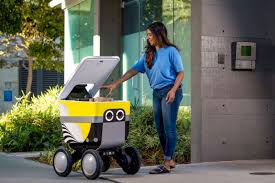
The bill would let delivery robots travel at twice their current speed
Tennessee lawmakers have advanced a DoorDash-supported bill that would set regulations for low-speed autonomous delivery robots, giving them access to certain roadways, bike lanes, and crosswalks while doubling their current speed limit.
Sponsored by Sen. Becky Massey (R–Knoxville) and 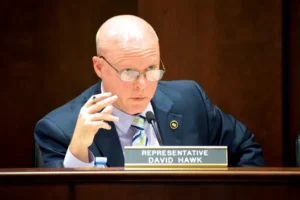 Rep. David Hawk (R–Greeneville), the legislation would expand both the range and allowable speed of autonomous personal delivery devices. It cleared its first round of subcommittee approvals in both legislative chambers this week.
“This doesn’t mandate their deployment in any community,” Massey explained, “but it does leverage autonomous technology for short-distance deliveries,” adding that the change could help merchants fulfill more local orders.
Brent Westcott, director of policy development for DoorDash, spoke in favor of the measure before the Senate Transportation Subcommittee on Wednesday. “To keep up with demand, we’ve been developing new technology to better serve customers and local businesses,” he said.
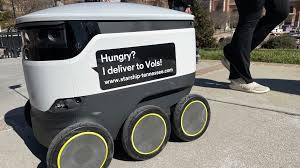 Westcott showcased “Dot,” DoorDash’s 350‑pound, cartoon‑eyed delivery robot that resembles a heavy-duty stroller and can carry up to 30 pounds at speeds up to 20 miles per hour. The robot has been in limited use in Tempe and Mesa, Arizona, since late 2025.
According to Westcott, the technology could help meet growing consumer demand, noting that more than 12,000 Tennessee businesses used delivery platforms last year and that DoorDash alone processed 44 million in-state orders in 2024.
The proposal updates Tennessee’s 2020 delivery bot law, which restricted the devices to sidewalks and crosswalks, by extending access to bike lanes and certain streets for faster models like Dot. However, similar robots introduced elsewhere have drawn criticism for blocking pedestrian paths and bike routes, raising safety concerns.
If passed, Tennessee would become one of the first states to formally allow personal delivery robots to travel off sidewalks. The new law would increase their maximum speed to 20 miles per hour. Local governments could still impose restrictions or designate no-go areas under state guidelines.
“If a road is just too busy — say, Broadway here in Nashville — local officials could say, ‘yes, but not there,’” Massey noted.
During a House Transportation Subcommittee hearing,  Rep. Justin Pearson (D–Memphis) questioned the bill’s potential impact on gig workers, warning that large-scale automation could displace human delivery jobs.
“We’ve got a lot of people in our communities who are gig workers,” Pearson said. “These kinds of automation and AI advancements affect both the local economy and people’s ability to make a living.”
Leave feedback about this