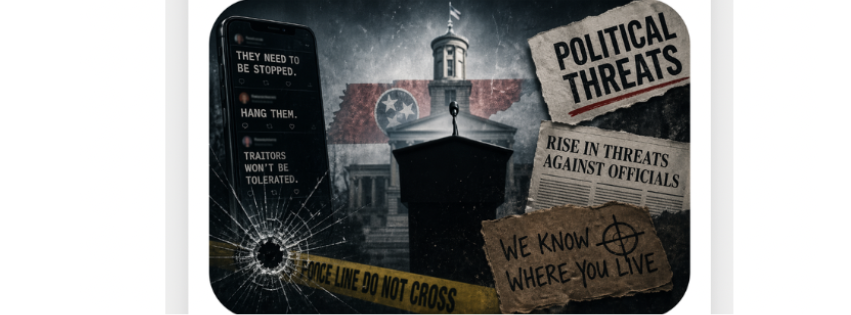
The threats are real. They are rising. And they are landing on both sides of the aisle.
The shadow of the 1960s looms large over today’s fractured political landscape, but the violence of the modern era carries a digital-age volatility that makes it uniquely dangerous. According to presidential historian and ABC News contributor Mark Updegrove, the United States is revisiting a level of upheaval not seen since a five-year span saw the assassinations of John F. Kennedy, Malcolm X, Martin Luther King Jr., and Robert Kennedy.
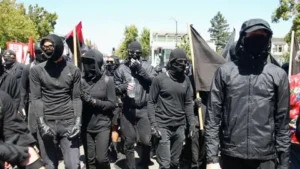
However, for many, these aren’t just historical parallels or headlines on a screen—they are lived experiences. I know this firsthand. A few years ago, I received a chilling call from Nashville attorney Doug Jones. “Sparks, you know you’re kinda a target,” he warned, mentioning “chatter” that Antifa was flying from Chicago to Nashville to target me and the Sam Davis Home.
The reality of that threat hit home at the worst possible time. I was scheduled to fly out on the C-17 Globemaster ‘Elvis from Memphis’ to watch the Tennessee National Guard’s 278th Armored Cavalry Regiment perform maneuvers at the National Training Center in Fort Irwin, California. I remember the heavy conversation with my wife before I left—discussing life insurance policies and pleading with her not to spoil our sons if the worst happened. The fear became a reality at 3:00 a.m. on my first night in California, when my wife called to tell me protesters were outside our home with bullhorns and drums. While I was proud of my sister Cindy for courageously confronting them, I was deeply unsettled by the experience—and disappointed that the local police didn’t do more to address the fear instilled in my family and neighbors.
The first C-17 Globemaster aircraft delivered to the Tennessee Air National Guard’s 164th Airlift Wing lands at Memphis International Airport. The C-17 Globemaster is a new era for the Tennessee Air National Guard. (U.S. Air Force photo/Tech.Sgt. Robin Olsen)
Heightened Political Threats
This personal brush with extremism underscores the broader crisis Updegrove describes. Following the recent fatal shooting of conservative leader Charlie Kirk at Utah Valley University—which Utah Gov. Spencer Cox labeled a “political assassination”—the focus has shifted to the engines driving this modern radicalization.
As FBI agents track the suspect and recover high-powered weaponry, Updegrove notes that while the 1960s were defined by discord, the current era is fueled by the algorithm.
“Social media gives us an opportunity to purvey extreme views from one side or the other with absolute impunity,” Updegrove said. “For social media purveyors, that enragement means engagement. It’s good for their business.”
Between the rise of mental health struggles and a digital landscape that rewards “enragement,” the threats we face today are not just real—they are escalating at a pace that our institutions are struggling to contain.
A deadly confrontation at Mar-a-Lago, Florida, is the latest in a string of high-profile security incidents raising concerns about political threats in America. Former Secret Service officials warn that low-tech, lone actors now pose one of the most difficult challenges to presidential protection.
Former Secret Service agent William “Bill” Gage told Fox News Digital that today’s most dangerous threats are often not sophisticated plots, but “super low-tech attacks by people with zero training,” using rudimentary methods. He noted that these individuals often blend into everyday settings. “If you were standing behind them in line at Starbucks, you wouldn’t have given them a second look,” Gage said.
Gage added that it should be clear that President Donald Trump faces an unusually high level of threat exposure. “It should be quite clear to all of us by now that Trump is the most threatened president in the history of the U.S.,” he said, pointing to multiple security incidents in recent years. He also emphasized that unlike past administrations where threat levels often declined over time, “the longer he’s president, the more these attacks keep happening.”
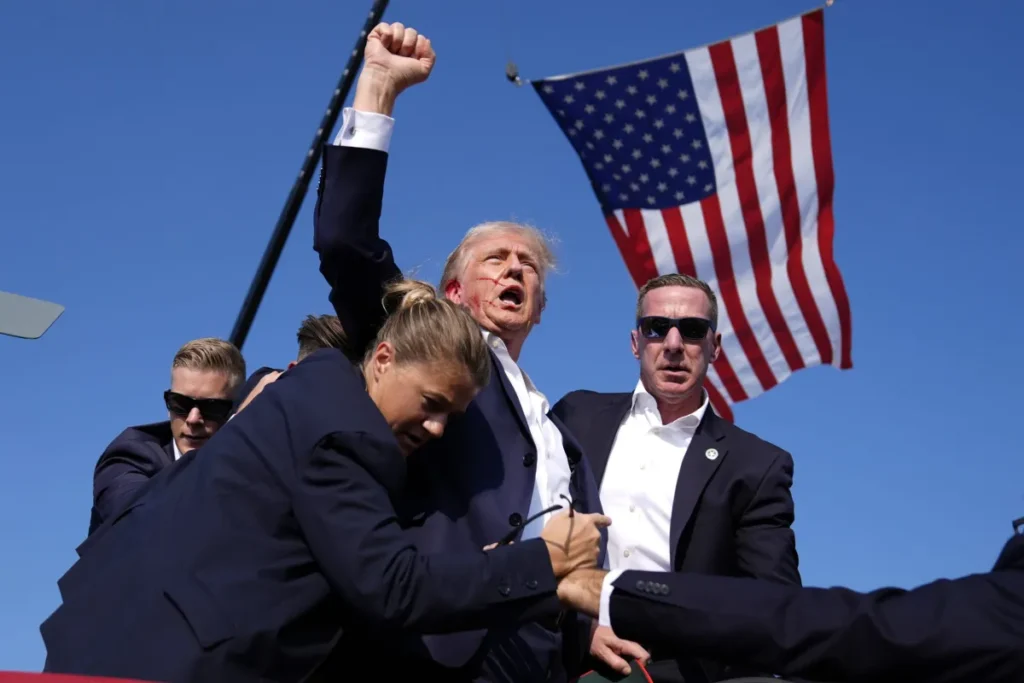
Former President Donald Trump is rushed offstage by U.S. Secret Service agents after being grazed by a bullet during a rally on July 13 in Butler, Pa.
This heightened concern comes in the wake of a widely reported assassination attempt on President Donald Trump during a campaign rally in Butler,Pennsylvania, where he was struck and injured in an attack that stunned the nation. The incident underscored how quickly political rhetoric can escalate into real-world violence and reinforced warnings from security experts about the growing threat from lone actors. Officials have pointed to that event as a turning point in how seriously agencies must evaluate even spontaneous, low-tech attempts against high-profile political figures.
In Michigan, U.S. Senator Elissa Slotkin reported receiving more than 1,000 threats in a single month — January 2026 — with more than 100 deemed credible enough to be under active federal investigation. State Rep. Sarah Lightner, a Republican, described threats to cut her throat, her spouse’s throat, and her children’s throats. State Rep. Joey Andrews said his office was “inundated” with death threats following the assassination of conservative activist Charlie Kirk.
These are not isolated incidents. They are symptoms of a national crisis in political violence that is reaching into state capitols, private homes, and the everyday lives of the men and women who chose to serve the public.
Tennessee has responded. And the response is Senate Bill 2320 and House Bill 2045 — now the law of this state.
“The threats went through the roof. We had over 1,000 threats come in. Over 100 were credible and are being investigated.” — U.S. Sen. Elissa Slotkin
A NATIONAL CRISIS COMING INTO FOCUS
The numbers are staggering. The U.S. Capitol Police investigated more than 9,400 threats against federal lawmakers in 2024 — up from 8,000 in 2023 and 7,500 in 2022. The agency projected it would handle more than 14,000 threats in 2025. That trajectory is not a blip. It is a trend.
7,500 threats in 20229,400 threats in 202414,000+ projected for 2025
The violence has not stayed in the realm of threats. In 2025, a series of incidents shocked the country. Conservative activist Charlie Kirk was shot and killed at an event in Utah. Minnesota State Representative Melissa Hortman and her husband were murdered in their home. Pennsylvania Governor Josh Shapiro’s residence was set on fire. Former President Donald Trump survived two assassination attempts. These are not hypotheticals. These are tragedies that have already happened.
Political science professor John Clark of Western Michigan University put it plainly: “So far, we haven’t come to a national consensus that the violence we’re observing in 2026 is not okay — but I think we will. I think we will come to a consensus on that, hopefully sooner rather than later.”
He is right that we need that consensus. But while we wait for it, the people serving in public office cannot be left without protection.
“Sometimes they write things — they’re going to cut your throat, your spouse’s throat, your kid’s throat.” — Rep. Sarah Lightner (R-MI)
THIS IS NOT A PARTISAN ISSUE
Let that sink in. A Democratic U.S. senator had a bomb threat at her home. Her parents were swatted in the middle of the night. Her siblings had police cars parked in their driveways. A Republican state representative received messages threatening to kill her entire family. A Democratic state representative’s office was buried in death threats after a conservative activist was assassinated.
The political violence gripping this country is not choosing sides. It is choosing targets from both. And the people who are targeted are the same people who ran for office because they believed in public service.
State Rep. Joey Andrews of Michigan said it best: “We really just need a temperature cool down on all levels.” That cool down cannot come soon enough. But in the meantime, Tennessee has taken a practical step to protect the people who serve while the temperature comes down.
WHAT TENNESSEE’S LAW DOES
Senate Bill 2320 and House Bill 2045, now law in Tennessee, make one clear and necessary change to campaign finance rules: expenditures of campaign funds for the security of a candidate or officeholder are not considered personal use of those funds.
Under existing law, campaign contributions are strictly regulated and cannot be used for personal benefit. That line exists for good reason — it prevents corruption and self-dealing. But the law, as written before this bill, created an absurd situation: an elected official who received credible death threats could not use their campaign account to pay for the security those threats required without risking a campaign finance violation.
That gap is now closed.
Any security expenditure made under this law must be disclosed on campaign finance reports as “security” — so transparency is maintained at the reporting level. But critically, the details of those security arrangements are confidential. In the event of an audit or investigation, information about security expenditures is not open to public inspection. That is not a loophole. Publicizing the specific nature of a candidate’s security setup would hand dangerous information to exactly the wrong people.
Candidates must maintain full documentation of all security expenses, meaning accountability exists — it simply does not exist on a public website for anyone with a grudge to read.
An elected official who received credible death threats could not use their campaign account for security without risking a campaign finance violation. That gap is now closed.
A SIMPLE BILL WITH SERIOUS MEANING
This legislation is two sections long. It takes effect immediately upon becoming law. It does not require a new agency, a new fund, or a new bureaucracy. It simply removes a legal barrier that should never have existed in the first place.
When someone receives threats because of the office they hold or seek, the cost of addressing those threats is a legitimate expense of holding or seeking that office. It belongs in the same category as yard signs and campaign mailers — not in the same category as personal expenses.
Professor Clark is right that we need a national conversation about political violence and a collective decision that it is not acceptable. Tennessee cannot cool the national temperature by itself. But it can make sure that the men and women who answer the call to serve in this state — from county commissioner to state representative to governor — have the tools to protect themselves and their families while they do.
That is what this law does. In a dangerous time, that matters.
SB 2320 / HB 2045 TAKES EFFECT IMMEDIATELY UPON BECOMING LAW
Security expenditures must be disclosed as “security” on campaign finance reports. Details of security arrangements are confidential and not open to public inspection.
State Representative Mike Sparks represents Rutherford County in the Tennessee House of Representatives and serves on the House Finance, Ways and Means Committee and the House Insurance Committee. He hosts “Conversations with Mike Sparks” Sundays on WGNS Radio (100.5 FM, 101.9 FM, 1450 AM).