This story hits close to home for me — and I think you should know why.
My father-in-law, Geary Smith, served 36 years as a lineman with Nashville Electric Service and is a Vietnam veteran. When I was dating my beautiful wife Felicia — now 40 wonderful years ago — I had a front row seat to what a lineman’s life truly looks like.
What I saw was a man who never made excuses and never asked for recognition. Ice storms. Severe weather. Middle of the night. Holidays. It did not matter. Geary Smith put on his gear and went out into it so that families across Nashville could stay warm, keep their refrigerators running, breathe easy through their medical equipment and the AC on during hot Summers.
There’s no doubt—I married well. And part of the reason I know that is because of the example I watched Geary set — quietly, faithfully, year after year, for 36 years.
Long before Tennessee law recognized it, Geary Smith was already living it. He set the example of what a true first responder looks like — and what it means to keep the lights on.
____________________________________________________________________
WHEN THE LIGHTS GO OUT, THEY GO IN
Tennessee Honors Fallen Lineman Chance Carlton With Landmark Legislation Protecting the Families of Those Who Keep Our Communities Powered
In the early morning hours of April 3, 2025, while a severe storm system tore across West Tennessee, Chance Carlton was exactly where his calling placed him — out in it.
“He loved his job. He cared about it very much. Any of the guys who work there could attest the same. He really loved his job. But more so he was strong in his faith and what he believed in,” said Samantha.
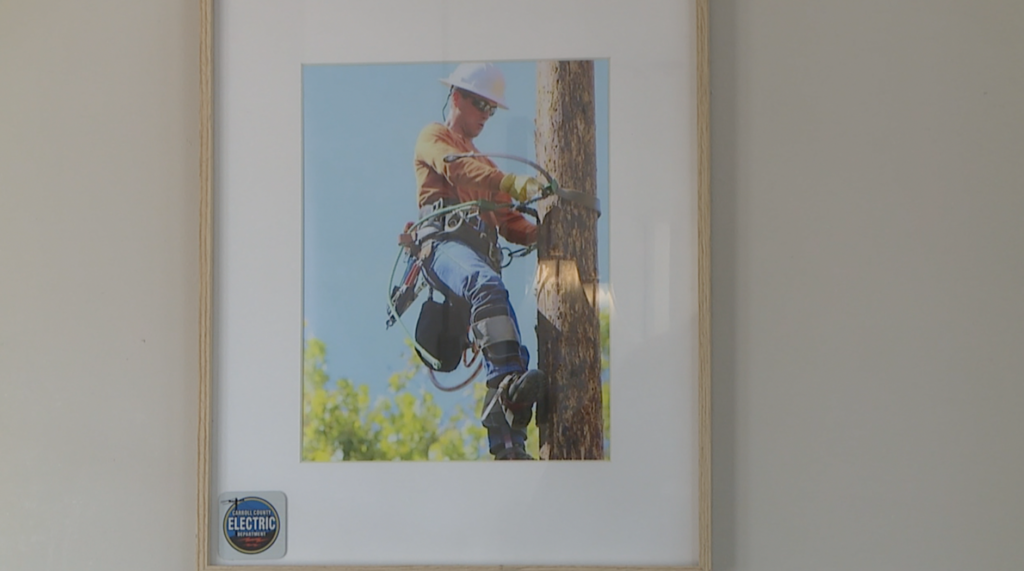
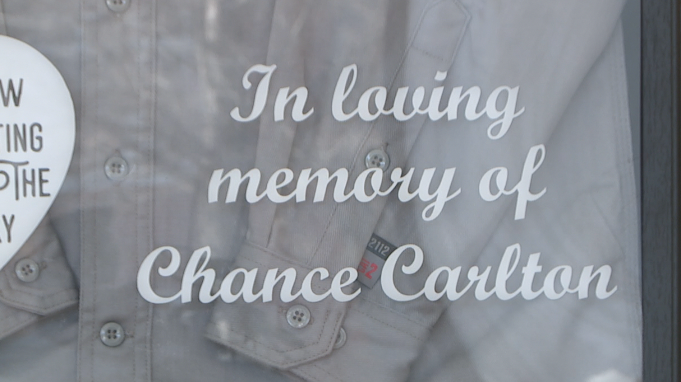
Carlton, 32, a lineman with the Carroll County Electric Department in Huntingdon, was working through the night to restore power to families sheltering from the storms. His truck left the roadway on Purdy Road near Roan Creek in the Clarksburg area. He was taken to Baptist Hospital Huntingdon, where he died. He left behind his wife, Samantha, and two young daughters, Landry Jean and Ellsie Jo.
Carroll County Mayor Joseph Butler, who had known Carlton his entire life, wrote in the aftermath:
Chance Carlton
“Chance was a Godly and dedicated husband, father, son, brother, colleague, and friend. A true public servant.” His church, Shiloh Missionary Baptist, called him a “faithful friend, a devoted father, and a man whose life touched so many.” He had led his congregation in hymns. He was a singer, a musician, a horseman, a bird hunter, and by every account, the kind of man a community cannot afford to lose.
On April 7, electric department trucks from across West Tennessee lined the streets of Huntingdon with their bucket booms raised high as Chance Carlton’s funeral procession passed beneath them. It was the kind of farewell reserved for those who served in dangerous places so that others did not have to.
“Whether it’s the middle of the night, a holiday, or the height of a storm, linemen always answer the call to keep our communities running.”
A GAP IN THE LAW
For years, Tennessee has provided a death benefit — $250,000 paid over five years — to the families of law enforcement officers, firefighters, and volunteer rescue squad members who die in the line of duty. It is the state’s way of acknowledging that some people go to work knowing that work can kill them, and that their families deserve a measure of security when the worst happens.
… Electrical linemen were not on that list.
Despite facing conditions as dangerous as any first responder — live wires in the rain, bucket trucks in high winds, flooded roads in the dead of night — linemen employed by local governments and their contractors had no equivalent protection. If they died in service to their community, their families navigated the same loss without the same safety net.
Chance Carlton’s death brought that gap into sharp relief.
House Bill 1464: Salaries and Benefits – As introduced, entitles the estate of an electrical lineman who was employed by or contracted with a local government to service electrical transmission and power distribution systems to an annual annuity of $50,000 for five years upon the death of the lineman in the line of duty. – Amends TCA Title 5; Title 6; Title 7, Chapter 51; Title 8 and Title 50.
Senate Bill 1907 and House Bill 1464, now known as The Chance Carlton Act, closes that gap. Effective July 1, 2026, the bill formally recognizes electrical linemen as a protected class under the same Tennessee law that governs death benefit annuities for emergency responders.
Under the act, an electrical lineman is defined as an individual who installs, maintains, or repairs electrical transmission and power distribution systems and who is employed by a local government or an entity that contracts with a local government for that work. The definition is deliberate and focused — these are the men and women keeping the lights on for Tennessee cities, counties, and rural communities.
The bill also adds a critical protection for families who may face a denied claim. Under the act, any denial of an annuity claim by the estate of a fallen lineman is subject to review by the Tennessee Department of Finance and Administration within 90 days of that denial. The department has authority to issue a final, binding order on the state — giving grieving families a meaningful avenue for recourse rather than leaving them to navigate a bureaucratic dead end alone.
Linemen work in dangerous, unpredictable conditions, often when others are told to stay off the roads. When tragedy strikes, their families deserve the same support.
WHO THIS BILL PROTECTS
The men and women this act covers are not strangers to risk. They climb wooden poles in ice storms. They work on live equipment in the rain. They drive heavy equipment through flooded rural roads at two in the morning because someone’s grandmother is on oxygen and the power is out. They do not choose the conditions. They just go.
According to the Bureau of Labor Statistics, electrical line installation and repair is consistently ranked among the most dangerous occupations in the United States. Falls, electrocution, and vehicle accidents — the very thing that took Chance Carlton — are the leading causes of fatalities in the trade.
Tennessee is not alone in grappling with this question, but it is now among the states taking meaningful action. The Chance Carlton Act ensures that a lineman’s family does not discover, in the worst moment of their lives, that the law they counted on does not cover them.
A NAME WORTH REMEMBERING
Bills named after people carry a special weight in any legislature. They are a promise that a life mattered, that a death was not simply absorbed into the machinery of government and forgotten. They put a name — a real one, with a family and a church and a community behind it — onto the law books of a state.
Chance Carlton was born October 30, 1992, in Huntingdon, Tennessee. He grew up there, played running back for the Huntingdon Mustangs, won a local radio station’s singing competition, and eventually found his calling stringing wire and restoring power to his neighbors. He died doing exactly that, at 32 years old, on a dark road in a storm.
His name will now appear in the Tennessee Code Annotated. That is a small thing, measured against what his daughters lost. But it is something. It tells every lineman in Tennessee — and the family waiting at home — that the state sees them, values them, and will not leave them behind.
The Chance Carlton Act, SB 1907 / HB 1464, takes effect July 1, 2026. Donations to the Chance Carlton Memorial Fund may be made at any Carroll Bank and Trust branch in Huntingdon, Tennessee.