Spencer Pratt Is No Longer a Punchline — He’s Karen Bass’ Biggest Problem
Why I’m Rooting for Spencer Pratt
I’ll admit it — I never thought I’d be writing about a former realty TV star.
But here we are in 2026, and the most authentic voice in the Los Angeles mayor’s race belongs to a reality TV star. Spencer Pratt is telling the truth out loud, without a script, without a consultant whispering in his ear, and without apologizing for it. You really can’t make this up — Spencer Pratt is keepin’ it real.
Who is Spencer Pratt?
Most Americans know Spencer Pratt from “The Hills,” the MTV reality series that made him a household name starting in 2006. The show was the brainchild of producer Adam DiVello — the same man behind Netflix’s “Selling Sunset,” which trades on the same Los Angeles backdrop, this time through the lens of luxury real estate drama.
But Los Angeles stopped being a backdrop for Pratt a long time ago. It became home.
He and his wife — fellow “Hills” alum Heidi Montag — built their life in the Pacific Palisades. Then January came, and the fires took it. The same city he’s now fighting to lead is the city that burned down his house.
That’s not a talking point — that’s skin in the game.
The Truth Matters.
Karen Bass has presided over a city where 62% of residents say things are headed in the wrong direction. Homelessness is consuming neighborhoods. Families don’t feel safe in their own parks. The Palisades fire exposed a leadership vacuum that no amount of carefully worded press releases could hide. And yet Bass kept right on governing like everything was manageable — like the people of Los Angeles just needed to trust the process a little longer.
Pratt just being ‘Honest’
What he’s doing mirrors what I’ve watched work at the national level. President Trump understood something most political consultants never will — that voters are less persuaded by perfectly crafted messaging than they are moved by someone who sounds like they actually mean what they’re saying. Pratt has that same quality. You can agree or disagree with him — but you always know where he stands.
As a conservative, I believe local government’s first job is to protect people and get out of their way. Los Angeles under Bass has done neither. When a city fails that basic test long enough, voters stop caring about credentials and start looking for someone willing to confront the real problems impacting their lives.
Spencer Pratt confronts the obvious. And right now, that is what Los Angeles.
”The prudent sees danger and hides himself, but the simple go on and suffer for it.” — Proverbs 22:3
If you told me five years ago that a reality television star would be running neck-and-neck with the mayor of Los Angeles, I might have laughed and many did laugh—the establishment laughed — they’re not laughing now.
A new poll conducted by McLaughlin & Associates for The California Post shows Spencer Pratt — yes, that Spencer Pratt — in a statistical dead heat with incumbent Mayor Karen Bass. Pratt leads with 30.1% support to Bass’s 29.5%, with Socialist councilwoman Nithya Raman close behind at 23.4%. The margin of error is plus or minus 4.9 points, meaning this race is genuinely up for grabs heading into Tuesday’s primary.
But the headline isn’t really about Pratt. It’s about what those numbers say about Los Angeles itself.
A City That’s Lost Confidence in Its Leaders
Sixty-two percent of likely Los Angeles voters say the city is headed in the wrong direction. That’s not a warning sign — that’s a fire alarm.
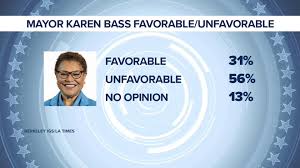
For Mayor Bass, the numbers are devastating. Only 32% approve of her job performance, while 66% disapprove — including 41% who strongly disapprove. Her personal favorability mirrors that: 32% favorable, 65% unfavorable. Those aren’t numbers you recover from easily, especially with days left before the primary.
John McLaughlin, CEO of McLaughlin & Associates, put it plainly: “Karen Bass has a huge disapproval, and she has a significant unfavorable rating.” He noted the race is “a lot more volatile” than most expected. “Normally it’s a slam dunk for the Democrats,” he said, “but it’s being driven by the negatives on Bass.”
What Voters Are Actually Angry About
The poll makes clear what’s fueling the frustration. Homelessness and mental illness top the list, cited by 26% of respondents as the number one issue facing Los Angeles. Housing affordability follows at 18%, with inflation and cost-of-living concerns at 13%, and crime and public safety at 7%.
These aren’t abstract policy debates. These are the conditions people live with every single day — and voters are holding their leaders accountable.
The Pratt Factor
What makes this race unusual is how Pratt has tapped into that discontent. His social media-driven campaign has electrified a voter base hungry for something — anything — different from the status quo. He leads among Hispanic voters with 33% support, compared to 24% for Bass and 21% for Raman.
Raman, meanwhile, has the strongest personal favorability numbers of the three — 40% favorable versus 42% unfavorable — but trails in the overall ballot test. McLaughlin notes she and Bass are competing for much of the same Democratic base. “There’s a Democrat primary within the primary,” he said, “and Raman’s competing with her and has more of an upside among those voters.”
The Clock Is Running Out
With only 5% of voters still undecided — down from 40% just three weeks ago — the field is largely set. The final weekend may be the last real opportunity for any candidate to move the needle.
“A lot depends upon who has a good weekend this weekend,” McLaughlin said.
The poll surveyed 400 likely Los Angeles voters between May 26 and May 28 through live phone and text interviews in English and Spanish, drawing from every major region of the city. Respondents were 52% White, 27% Hispanic, 10% Black and 9% Asian, with Democrats accounting for 64% of the sample.
Whatever you think of Spencer Pratt, this much is true: when a reality TV star is within the margin of error of a sitting big-city mayor, something much larger than one candidate is going on. Los Angeles is searching for answers — and so far, nobody has given voters a reason to stop looking.