
This article originally appeared in Shelbyville Now
House Says Fix It. Senate Says Ignore It. So Who Are They Really Representing?
By- David Thomas
The Tennessee legislature just delivered two completely different answers to the same question, and when you break the votes down into percentages, the contradiction becomes impossible to ignore. In the House, the bill to restrict county employees from serving on county commissions passed with overwhelming support—approximately 87% voted in favor, while just 13% opposed it. That is not a divided chamber. That is a decisive mandate. Then the bill moved to the Senate and collapsed just as dramatically in the opposite direction—roughly 28% supported it, while 72% voted against it. Two chambers, both with overwhelming majorities, but moving in completely opposite directions.
That kind of split is not normal. It is not a difference of opinion. It is a direct contradiction on a basic issue of public ethics, and it raises a question that cannot be ignored: if both chambers are supposed to represent the same people, how can they be this far apart?
The issue itself is straightforward. Should a county employee be allowed to sit on the same commission that governs the county where they work? That means voting on budgets, policies, and decisions that directly affect their own job. Most people do not need a legal explanation to see the problem. It is common sense.
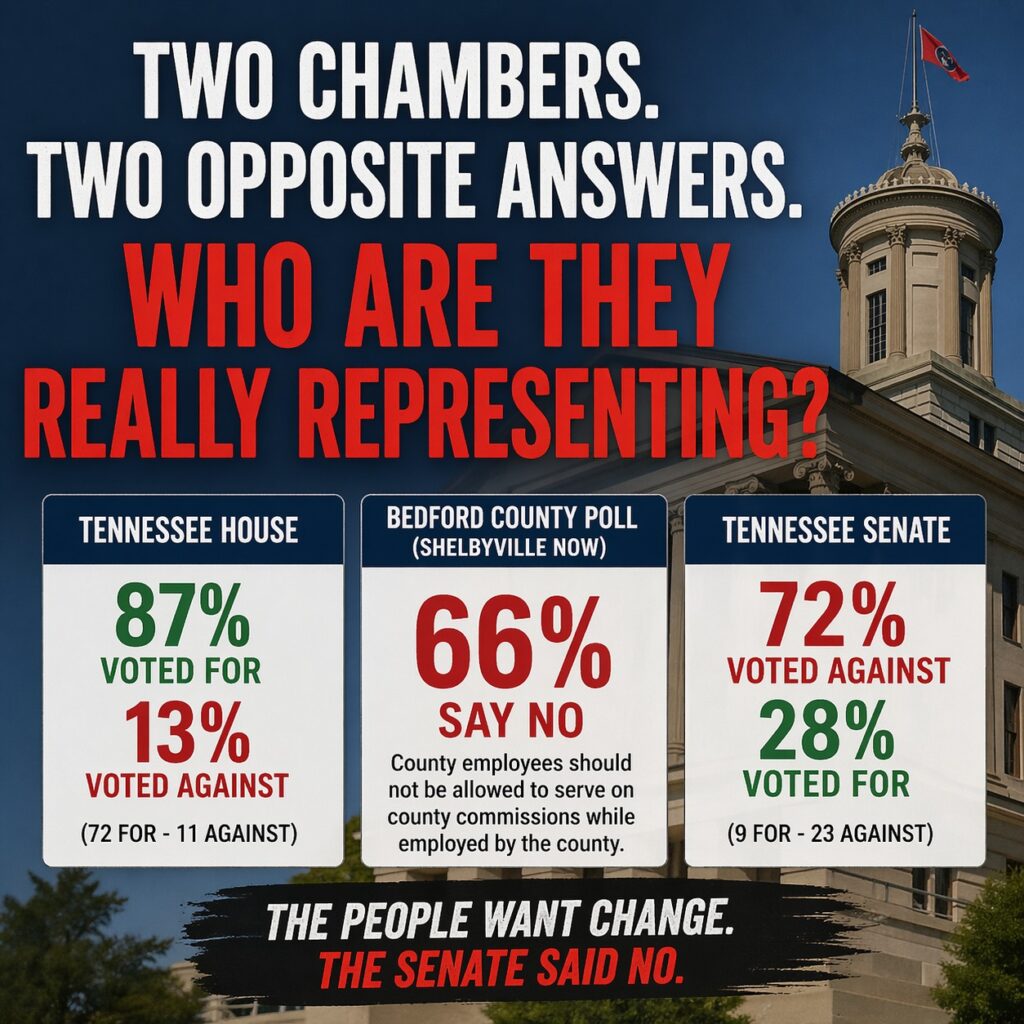

And when you look at local sentiment, the gap becomes even clearer. A Shelbyville NOW poll asked Bedford County residents where they stand on this issue. Only 9% said county employees should be allowed to serve without restriction. Another 23% said they could serve, but only with strict recusal rules. That leaves a clear majority—66%—who said county employees should not be allowed to serve on county commissions at all while employed by the county, with just 2% undecided.
Those numbers are not close. They show a strong local consensus leaning toward reform.
Now compare that to what happened in Nashville. The House vote, at 87% in favor, aligns much more closely with that concern. The Senate vote, at 72% against, does not. Not even close. When one chamber overwhelmingly supports a bill and the other overwhelmingly rejects it, the issue is no longer about policy nuance. It becomes about representation.
There are arguments made in defense of the current system. In smaller counties, people often wear multiple hats, and limiting who can serve could shrink the pool of candidates. That may be true in practice, but it does not eliminate the conflict. It simply explains how the system developed. The real question is whether it should continue, and based on local sentiment, a majority of people believe it should not.
The House appeared willing to address the issue, even with compromises such as delaying implementation and allowing current officeholders to remain. The Senate took a different path. It did not adjust the bill. It rejected it outright. When lawmakers take that kind of position, they owe the public a clear explanation.
Because right now, the numbers do not line up. 87% of the House supported the bill. 72% of the Senate opposed it. 66% of local respondents want change. Those figures are not moving in the same direction, and that raises a fundamental question about who is being heard.
This is not just about one piece of legislation. It is about trust. When voters see a clear issue and one branch of government moves to address it while another blocks it, confidence in the system starts to erode. People begin to question whether decisions are being made based on public interest or something else entirely.
This issue is not going away. The divide is now out in the open. And the next time it comes up—and it will—lawmakers are going to have to answer for it. Because when the percentages tell two completely different stories, the question becomes unavoidable.
… Who are you really representing?
David Thomas: Sports, Politics, and Commentary
David Thomas was born and raised in Shelbyville and has been a small business owner for most of his adult life.