Holy Week begins on Palm Sunday and ends with Easter Sunday. During this sacred week, many biblical prophecies were fulfilled as Jesus came to earth to save humanity—dying on the cross on Good Friday and resurrecting on Easter Sunday.
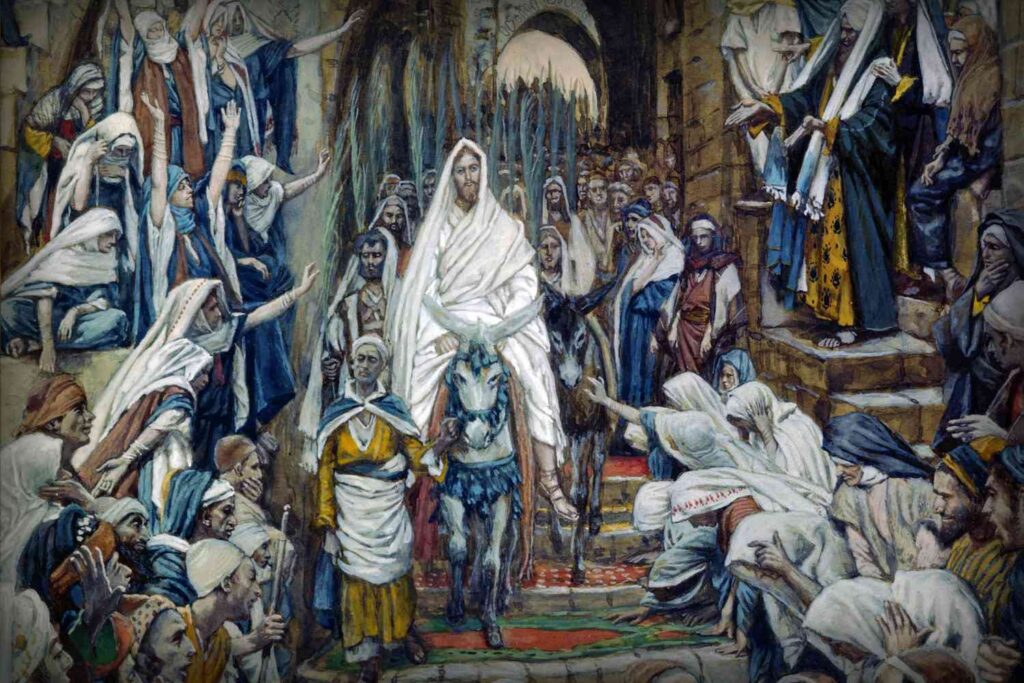
One powerful example is the prophecy of peace and humility from Zechariah 9:9 (written centuries earlier): “See, your king comes to you, righteous and victorious, lowly and riding on a donkey, on a colt, the foal of a donkey.” By deliberately choosing a donkey instead of a warhorse on Palm Sunday, Jesus fulfilled this prophecy and demonstrated that He was bringing peace and spiritual salvation, not military conquest. This act symbolized His profound humility, fulfilling His role as a servant-king rather than a political ruler.
It’s a good guess that you, like me, would have heard it said, on more than one occasion, that “Jesus rode a donkey into Jerusalem to protest against the Jews, to tell them that he would not be the military king that they desired.” According to this view, Jesus chose to ride into Jerusalem on a donkey, rather than a horse, to signal that he was a man of peace, and also that he would not be acting in the way that the Jews were expecting the Messiah to act.
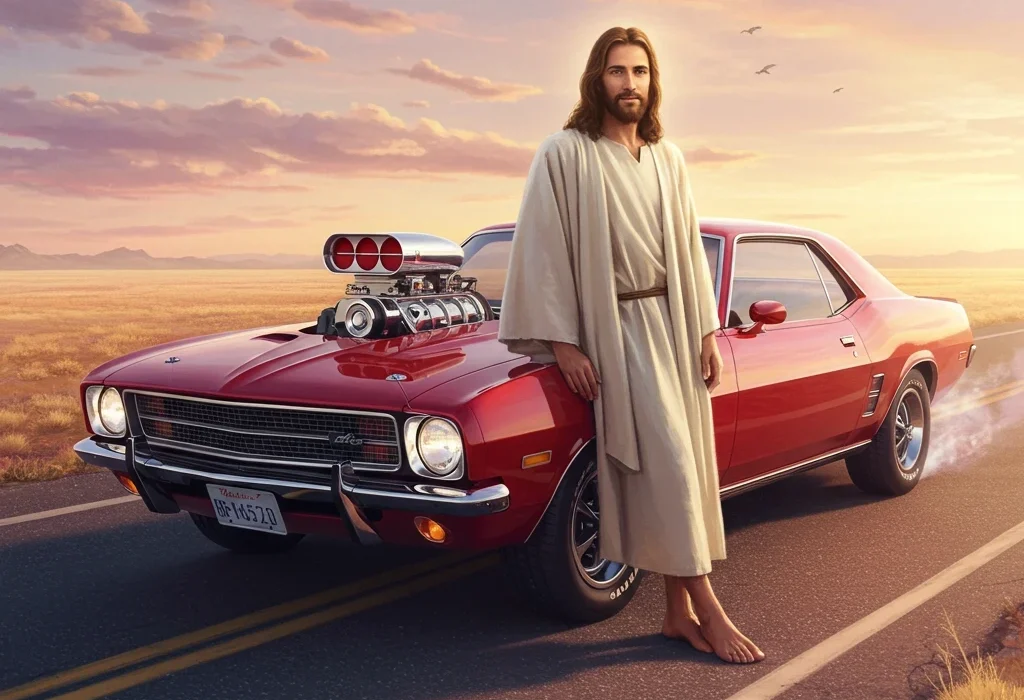
My pastor brother Shelby Hazzard—who’s a true “car guy” and a good mechanic—offers a helpful modern analogy: Jesus choosing to drive a humble Ford Pinto rather than a muscle car. Imagine opting for that unassuming economy car instead of something powerful like my favorite, the 1969 Chevrolet Camaro ZL1 (which ranks high with its 427 cubic-inch all-aluminum V8 rated at 430 horsepower—likely 500+ in reality—delivering 0-60 mph in about 5.3 seconds and dominating NHRA races) or the torque-monster 1970 Buick GS 455 Stage 1 (boasting 360 hp and a massive 510 lb-ft from its 455 V8, enabling brutal street launches around 5.5 seconds to 60 mph). The contrast makes the point of humility and peace crystal clear.
John Wesley Chisholm’s “The Easter Atheist” on Substack (2024) weaves a compelling parable about God creating atheists to underscore the importance of active faith in action. Christians can draw several key lessons from this thought-provoking piece, which originated from a deep religious conversation exploring divine purpose.
Lessons from “The Easter Atheist”
•Lesson on Compassion: Atheists often demonstrate true compassion through charity and practical help, driven purely by inner morality rather than expectation of divine reward. This challenges Christians to act selflessly, moving beyond prayer or doctrine alone into tangible, hands-on service.
•Call to Action: When someone is in need, Christians should respond directly with “I will help you,” rather than deferring solely to God. The parable invites us to imagine a world without divine intervention, spurring greater personal responsibility and immediate action.
•Value Good Intentions: Even good deeds can lead to unintended consequences, yet Christians must prioritize ethical action and resolve—living out the Golden Rule—over passivity or fear of imperfect outcomes.
•Choose Useful Beliefs: Beliefs should be evaluated by their fruit: their ability to inspire good works and combat despair. Acting “as if” Christian truths are real can promote a better world, beautifully bridging faith and practical living.
•Embrace Imperfection: Human motivations are often a mix of genuine good, mediocrity, and error. Yet Christians are called to persist in trying, allowing stories—whether from movies, scripture, or parables—to shape behavior for the better, regardless of ongoing debates about literal truth.
“Someone Has Come Along…” Patrick Stewart as Charles Xavier says to Logan in the 2017 heyday of the Marvel universe.I’m not one to marvel at Marvel, but this scene sticks with a person. As it should. But why did Logan stop and help the people in need? He didn’t believe in God. And what does it mean if it ultimately didn’t help?As Steve Neumann puts it:
“Admit it—you’re probably thinking that we nonbelievers wake up late on Easter Sunday, keep the shades drawn all day, and drink bitter black coffee while we sit around and recite sections of The God Delusion or The End of Faith. And maybe throw eggs at passersby on their way to church.”
The Easter Athiest
In Martin Buber’s 1947 book Tales of the Hasidim, a collection of stories on the theme of non-judgment, he shares a story of a religious conversation about why God created Atheists.
“God created atheists to teach us the most important lesson of them all – the lesson of true compassion. You see, when an atheist performs an act of charity, visits someone who is sick, helps someone who is in need, and cares for the world, he is not doing so because of some religious teaching. He does not believe that god commanded him to perform this act. In fact, he does not believe in God at all, so his acts are based on an inner sense of morality. And look at the kindness he can bestow upon others simply because he feels it to be right.”
The conclusion is, “that when someone reaches out to you for help, you should never say ‘I pray that god will help you.’ instead for the moment, you should become an atheist, imagine that there is no god who can help, and say ‘I will help you’.”
The joke is that the atheist thereby proves the ineffable existence of the thing they profess to deny – the goodness of God. And along the road Christians learn that their’s is not a passive creed.
You Kant Do That
Emanuel Kant, a titan in the realm of philosophical inquiry, wrote that the only thing that can be considered good without qualification is a good will.
Kant’s claim implies that the moral worth of an action is not determined by its outcome, but by the intention behind it. A will to do good, according to Kant, is inherently good in itself, regardless of the fruits it bears. This perspective shifts the focus from the consequences of actions to the motivations driving them, placing ethical emphasis on the purity of one’s intentions.
This is important in a complex world where unintended consequences are the norm, not the exception. And that’s what ultimately played out in Logan.
It’s a call to value the resolve to do right, even when the right thing sometimes doesn’t lead to the best outcome. This philosophy underlines the essence of ethical behavior and Christian belief (doing unto others as you would have them do unto you, not how they actually do), spotlighting the intrinsic value of good intentions in the complex chain of human actions.
Mediocrity is Everywhere
“Our conscience should never release us from concern for the problems of the day.” wrote Admiral H.G. Rickover in a speech in 1956. It’s a phrase highlighted in every Naval Officer training textbook since to help people think clearly within the tin-can society of a ship at sea.
James Cambon said: “We have to defend the country against mediocrity: Mediocrity of soul, mediocrity of ideas, mediocrity of action. We must also fight against it in ourselves.” It is a lonely and hard thing to speak out against mediocrity or the evils of the system. One feels the frustration that arises only in those who are compelled to act. The detached spectator does not feel this helplessness because they never try to surmount the problems that exist. The spectator is a person who has no conscience, who doesn’t die, who cannot laugh, and who is unaware of personal responsibility. They do not necessarily do wicked things, but they do passive things. There are many spectators in the world today who choose passivity. They will do anything so that their accustomed life is undisturbed, anything so as not to cross over into hardship today; at the same time, they hope tomorrow will take care of itself.
We’re The Ones Who’ve Come Along
But we’re the ones who’ve come along. The tools we have to shape the future: media, stories, communication, and democracy are slow, unwieldy, and difficult to navigate. Often riddled with unintended consequences. It takes a huge amount of courage to speak out or pitch in. And the results are so slow to come that the sour and bitter voices can always claim victory in the short run – nothing ever changes as fast as we would like and seldom in a straight line to victory as democracy careens from pillar to post.
Ultimately, our reasons may change. Our motivations may be mixed. Our own mediocrity may be the enemy to beat all things. There will almost certainly be unintended consequences, and good works often get mixed with mediocre and even, seldom but seriously, evil. But we just need to find a reason, any reason, to keep trying.
Believe What Is Best
Maybe the question is, what beliefs serve you best? If one way of looking at things just makes you sad and want to stay in bed, and another way makes you want to jump up out of your chair and take action, choose the way that leads you to action, to do good. If it’s a useful belief that makes things better for everyone – choose that! The world is filled with mystery beyond imaging and thoughts beyond our thoughts which we must confine to the most narrow and guarded mental borders. So, who knows? Choose the beliefs that serve you best and then behave AS IF those are the truth. It’s a strong argument for holding the Christian creeds.
Few of us would ever go astray in life by doing only, and behaving only, as our mothers would have us behave. Is every mother a font of knowledge and truth? No, but if we behave as if it were so the world would be a better place. It’s likewise with our Christian faith. How different is it to say “I believe as an article of faith.” and “I act as if believe because it is best.”?
Our knowledge of The Truth is severely bounded to what is observable, repeatable, logically or mathematically provable, and we are so short on potential experience that we have little time to genuinely work all this out, so through human history, we’ve gone with systems of belief that led to the most possible good. Now the more experience we get and the bigger we’re able to think – beyond ourselves, our family, our tribe, or our community – we can take on beliefs that do the most good for all the people, the future, and the planet. We’ll be wrong just as often. And our guiding light will be just as benighted as the ancient ones we now criticize. But it’s the intention that matters.
Useful Not True
In Derek Sivers new book USEFUL NOT TRUE there is a great section on the notion that in thinking it is the case that All Lines Are Curves. He looks at the other side of this coin and proposes we:
Refuse any modern ideology (such as Atheism, Identity Politics, Conspiracy Theories, Anti-Government Ranting, or any other bitter, sour, stuff that is on digital loudspeaker these days ) when it declares an entire creed collection as false and bad, insisting you discard all useful ideas – or even history itself – if their bundle is imperfect.
Break apart the packaging of beliefs and consider them based not on an obsession with truth, but in consideration of the usefulness of their component parts and their intention. For example, many of us come away from movies or books saying ‘Wow, that had a big impact on me’, knowing very well they are fictional stories and characters who nonetheless live in our minds, sometimes for a lifetime, played by actors with faults and foibles of their own. Yet in the same way, we rave about and dismiss biblical or other religious stories because they are ‘not true’ or contain parts that don’t suit our current popular thinking.
Pick individual ideas, regardless of their origin or messenger.
Pick the Beliefs that do the most good.
Alden Nowlan (1933-83) was a critically acclaimed Canadian poet, novelist, and playwright, and regarded as one of the most original voices of his generation. Nowlan was born into rural poverty in Stanley, Nova Scotia, along a stretch of dirt road that he would later refer to as Desolation Creek.
He wrote an astonishing verse about Social Workers and the will to do good.
The Social Worker’s Poem Alden Nowlan
“You know them better,” said the girl,
whose face glowed with benevolence as from
too much cosmetics, speaking of the poor.
“What can you tell me that might help?”
She planned to do summer social work in a slum.
Do it as a bribe to God, I answered.
Do it because you hate morons and dirty underwear.
Do it because you are one of those who a sense of power
causes to breathe deeply and exhale aloud as if
it were a richer oxygen.
Do it to cure or satisfy some obscure sexual deviation.
But, above all, I said, don’t act from a desire to be loved.
Don’t ask so great a payment for your services.
You’ll wind up as bitter as the corner grocer
who gave too much credit and went bankrupt.
And remember, Miss,
your admonishments
they’ll find as irksome as
you’re finding these of mine
Take my word for it. They’re human.
Most of them will hate you.
As if !
In 1834, David Strauss published his book, The Life of Jesus, Critically Examined, and it went off like a stick of dynamite in a fireworks factory. One reviewer stated that it was “the most pestilential book ever vomited out of the jaws of hell.” It quickly became a controversial literary phenomenon that eroded the belief in the Bible as a historical book.
A few years later, Nietzsche is famous for proclaiming God is dead but that line belies the complexity of his philosophy. Nietzche mocked many atheists because they refused to take their non-beliefs to their natural conclusions. He thought too many atheists imagined they could hold on to all the well-known Christian values and morality without Christ. 150 years later millions more are walking that line today. There’s a good chance you are one. The world is filled with nonbelievers who absolutely believe in Christian values.
For me, that 200-year journey of philosophy from faith to Nihilism to Existentialism, to Absurdism, really only took a few evenings in the company of Aristotle, Copernicus, Newton, Darwin, Nietzsche, Kant, Kierkegaard, David Hume, Albert Camus, and the rest. I opened myself up to embrace the insatiable tension, to embrace the Absurd, to lean into it.
Now I am an openly, uncloseted Absurdist. I behave, I live, and I suppose even believe AS IF God exists and the received Christian wisdom is true. It directly addresses the principal human problem of suicide and builds the bridge over the leap of faith Christianity requires us to construct. Absurdism rejects both the supernatural and the natural interpretations of Jesus in favour of a “mythical” embodiment of the essential Christian message. It’s a good life. A supermarket that sells both science and sorcery.
And consciously or not, I’m not the only one living this way.