Sparks Media of Tennessee Faith Fatherless in Tennessee: Why This Crisis Demands Our Attention
Faith Leaving a Legacy

Fatherless in Tennessee: Why This Crisis Demands Our Attention

Each year, U.S. judges issue an estimated 2 to 3 million temporary restraining orders, with roughly 85% directed at men. Many believe a significant share are used strategically in divorce and custody disputes—what some call the “gamesmanship of divorce.” But the consequences are far from a game, especially for fathers separated from their children.
America has a fatherless crisis. Nearly one in four children grow up without their father in the home, and the consequences are well documented. Studies link father absence to higher rates of incarceration, addiction, teen depression, and youth suicide. Father involvement is one of the strongest known factors in lowering teen pregnancy rates.
It isn’t just social—it’s economic. A 2026 update from the National Fatherhood Initiative estimates the federal government spends $154.2 billion annually on assistance tied to father-absent households. The flip side is just as clear: children with involved fathers perform better in school, exhibit fewer behavioral problems, and experience stronger long-term health outcomes. A father’s presence is not a bonus—it is a public health intervention, which is why I have sponsored HJR 131 and HJR 179 in the Tennessee General Assembly.
Before addressing crime, poverty, or mental health, we must confront this deeper issue. Nearly 18 million American children are growing up without a father at home, and that number is expected to rise.
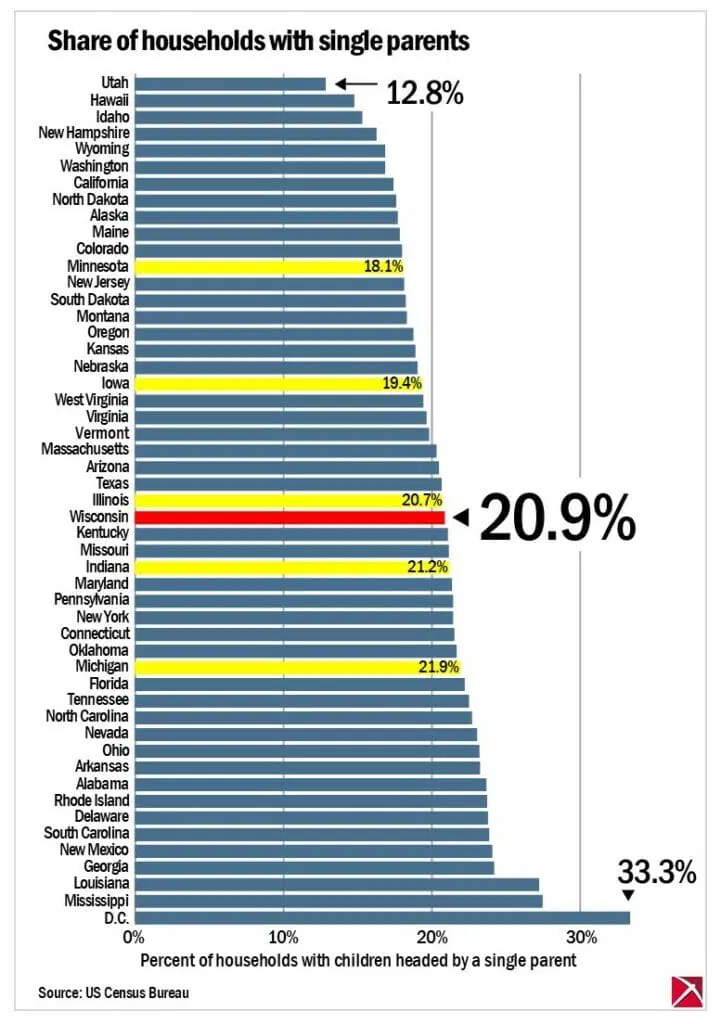
Tennessee is not immune. In fact, it may surprise many that our state ranks among the worst for father absence. According to the Badger Institute, Tennessee ranks 28th among states and Washington, D.C., with 22.5% of children living in single-parent households. Yet, this crisis receives little attention. I would argue this is one of the most critical issues facing both our state and our nation. While roughly 330 lobbyists operate in Nashville—some earning more than the legislators themselves—this foundational issue affecting our children and communities is too often overlooked.
Research consistently shows that fatherlessness is a strong predictor of crime and instability. Boys without fathers are far more likely to engage in delinquency, and a large majority of incarcerated youth come from fatherless homes. Studies also link absent fathers to higher rates of violence, teen pregnancy, and school dropout—costing taxpayers billions each year.
Mental health outcomes are equally troubling. Children without fathers face higher risks of substance abuse, behavioral disorders, and suicide. Most children with serious behavioral challenges come from single-parent homes.
Despite decades of evidence, cultural and legal trends often minimize the importance of fatherhood. Family court systems can, at times, incentivize conflict rather than fairness, allowing tactics that separate fathers from their children without long-term accountability.
Denying a child the presence of a loving father limits that child’s potential. Strengthening and supporting fatherhood is not optional—it is essential to building healthier families, stronger communities, and a more stable nation.

____________________________________________________________________

By JOHN BLASE
God’s Word clearly indicates that fathers bring power to the parenting relationship.
As I watched the movie with my children, there were the usual suspects: a cute little girl, a dog, and a father who didn’t know he had a daughter but was about to get his chance at redemption. Throw in some Elvis Presley tunes and competitive professional sports for dramatic effect, and you’ve got one of those feel-good movies that tug at your heartstrings while tickling your funny bone.
Throughout the movie, the main character kept saying, “the power of the father.” What started out as a phrase to help him stay focused in his newly discovered role became something more: the belief in the importance of a father’s role in child development, giving his children something that no one else can. And while this film was no Old Yeller or Mr. Smith Goes to Washington, it did manage to successfully ask, “Do children really need a father?” Even in the midst of Hollywood dips and turns, the answer was clear: Yes, there really is a power that only a father brings to his children.
Anytime I see a film that even remotely acknowledges such a truth, I’m thankful. Much of our media does not believe in the importance of a father’s role in child development, and those that include dads in a script often portray them as absolute idiots. It’s sad, really. Actually, it’s a disgrace.
The Importance of a Father’s Role in Child Development
The pattern established in the beginning emphasized the importance of a father’s role in child development:
“For this reason, a man will leave his father and mother and be united to his wife, and they will become one flesh” (Gen 2:24).
A man would leave his father and mother and take a wife. They would be fruitful and multiply. The children would benefit from both parents, as each one would bring different and necessary facets to the child’s life. This was the pattern, the divine design.
I realize the phrase “power of the father” might stir up less-than-desirable reactions from some. The word “power” is used for good or evil. But just because some have and will abuse the reality behind the word, there’s no need to write it off. God’s Word clearly indicates that men — fathers — bring power to the parenting relationship. The woman brings life, and the father brings strength. There will be days when a mother brings strength to things, and there will be days when a man brings life. But the abiding pattern, the divine design, gives power to the father. The question, as always, is, “How will the power be used?”
How Fathers Influence Their Children’s Lives
I hope this series will cause you to stop and ponder a little — or maybe a lot. A father’s presence underscores the importance of a father’s role in child development. The permission a father gives differs from that a mother offers. It’s not necessarily nice to point, but a father had better set nice aside from time to time and point out a few things along the way. If he doesn’t, then who will?
As a father, you may read these articles and think, “My father never did those things for or with me!” As a result, these words may bring pain to the surface. Please remember that if we don’t seek to transform our pain, we’ll just transfer it to others — often our sons and daughters.
The Power of a Father’s Presence
The love of our heavenly Father can redeem any pain and transform it into something strong, solid, and powerful, highlighting the importance of a father’s role in child development. Fathers, we all get a second chance — maybe many chances — at redemption. A redeemed father’s power might just make the difference in a little girl or boy’s life.
Exit mobile version