Younger adults are less comfortable than older adults with initiating kind acts toward strangers
Publisher’s Note — Mike Sparks
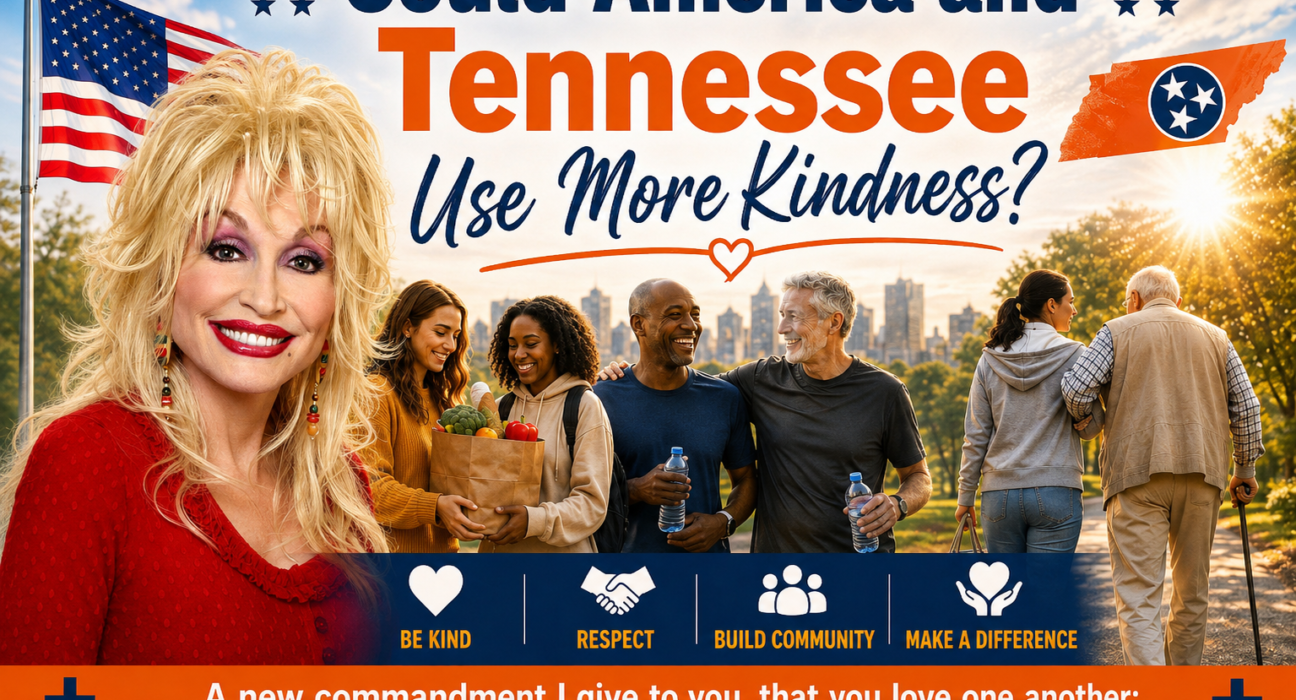
As I sat down to share this article about whether America and Tennessee could use a little more kindness, the heartbreaking news came that Tennessee had lost one of its greatest treasures, Dolly Parton.
WWDD? What Would Dolly Do?
The timing struck me. Here I was thinking about kindness and how we treat one another when the news came about a woman whose life and career became synonymous with faith, generosity, humility and kindness. I often see the opposite: Doubt, Selfishness, Excessive Pride …and Cruelty—disturbingly visible online. I saw a terrible comment about someone’s death.
It also brought back memories of one of the most meaningful pieces of legislation I have had the privilege of working on in the Tennessee General Assembly — recognizing “Amazing Grace” as an official Tennessee State Song.
But there is a part of that story that deserves to be told.
I was looking for a way to tell the story of how slavery had needed in Great Britain 33 years before America where it cost our country roughly 650,000 lives. The miraculous story of the hymn Amazing Grace. When we were working on the legislation, I turned to my assistant at the time, Marvin, a 24-year-old African American from Memphis, and asked him a simple question:
“What singer in Tennessee does everyone seem to really like?”
He quickly answered…”Oh, that’s easy. It’s Dolly Parton.”
In fact, the idea of specifically recognizing Dolly Parton’s version of “Amazing Grace” was Marvin’s idea — not mine.
I have always loved that story because, in many ways, it represents what the song itself is about. Here was a young African American man from Memphis helping shape legislation involving a hymn written by a former slave-ship captain whose life was dramatically transformed by Christian faith and who later became part of the movement that helped bring an end to the British slave trade.
Ultimately, Senator Raumesh Akbari and I worked to pass legislation recognizing the iconic hymn “Amazing Grace” as an official Tennessee State Song.
… And what a powerful backstory that hymn carries.
John Newton spent part of his early life involved in the horrific transatlantic slave trade. His encounter with the Christian faith gradually transformed his life. Newton eventually became an Anglican minister, and while serving a congregation in Olney, England, he wrote the words that would become one of the most recognizable Christian hymns in history.
“Amazing grace! How sweet the sound,
That saved a wretch like me…”
Those weren’t merely poetic words. They reflected Newton’s understanding of his own sin, redemption and the transforming power of the Gospel.
Newton’s story would eventually intersect with another remarkable Christian, William Wilberforce, a wealthy, Cambridge-educated member of the British Parliament.
Wilberforce considered leaving politics for ministry after his own Christian conversion. Newton encouraged him instead to remain in Parliament and serve God where he had been placed.
That decision helped change history.
Wilberforce, Newton, Thomas Clarkson and other abolitionists spent years exposing the brutality of the slave trade. Clarkson gathered evidence. Newton provided firsthand testimony about the horrors aboard slave ships. Wilberforce became the political voice of the movement in Parliament.
They faced defeat after defeat, but they kept going.
Finally, in 1807, Parliament abolished the British slave trade. Wilberforce lived long enough to see legislation abolishing slavery throughout most of the British Empire pass Parliament in 1833, just days before his death.
That history makes “Amazing Grace” much more than a beautiful song.
It is a story about sin, repentance, redemption, perseverance and the power of faith to change a human heart.
And I believe that message is needed today.
Dolly Parton’s rendition seemed especially fitting for Tennessee. She never forgot where she came from. She carried her Tennessee roots around the world while using her success to help others. Through efforts such as childhood literacy and countless acts of generosity, she demonstrated that success and humility don’t have to be opposites.
During the COVID-19 pandemic, Dolly said she hoped we would learn to see ourselves and one another “through the eyes of love.”
That message seems especially appropriate now.
Our country can feel terribly divided. Politics, social media and cultural disagreements can tempt us to view people who think differently as enemies rather than neighbors.
Maybe we need to rediscover something very simple:
Kindness isn’t weakness. Compassion isn’t surrender. Loving your neighbor doesn’t require agreeing with your neighbor.
Jesus said:
“A new commandment I give to you, that you love one another: just as I have loved you, you also are to love one another.” — John 13:34
As Tennessee remembers Dolly Parton, perhaps one of the best ways we can honor her isn’t simply by playing her songs.
We can practice a little more kindness.
And perhaps, in a world still filled with plenty of “dangers, toils and snares,” America — and Tennessee — could use a little more Amazing Grace.
____________________________________________________________________
BY JEFFREY M. JONES
Solid majorities of Americans observe kindness being practiced in society as well as toward them, personally. And while slightly more than half of Americans say they are very comfortable initiating acts of kindness toward strangers, younger adults are much less likely to be comfortable doing so than older adults.
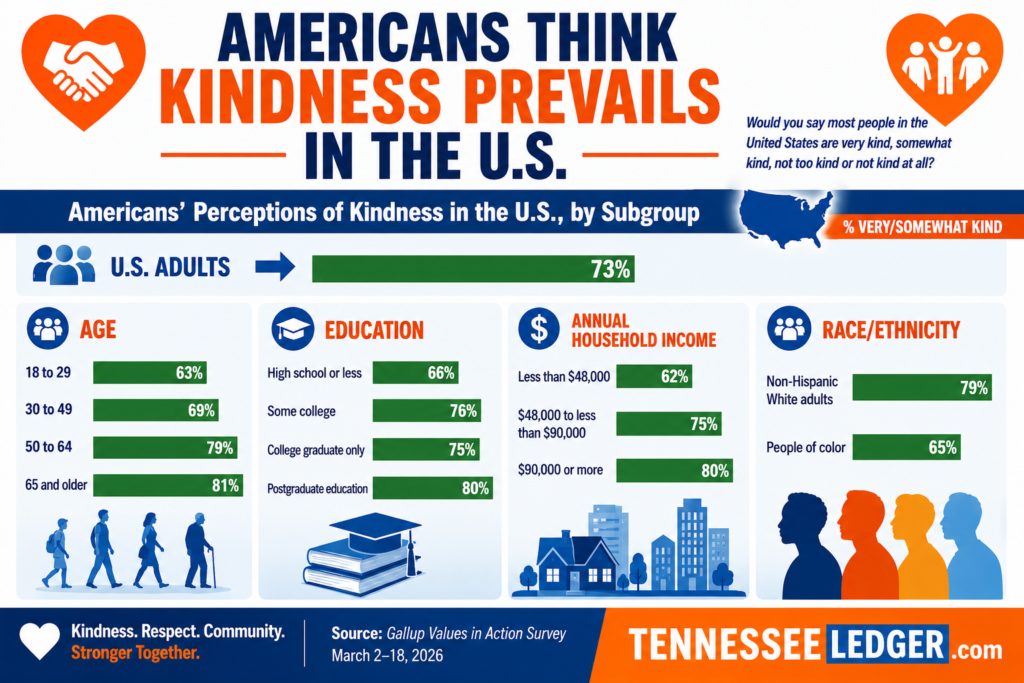
More broadly, most Americans believe people in the U.S. are at least somewhat kind; their assessment is strongly related to how often they personally witness acts of kindness.
These results are based on a Values in Action/Gallup survey of more than 2,000 U.S. adults interviewed by web March 2-18 using the Gallup Panel.
Solid Majorities Report Seeing Kind Acts
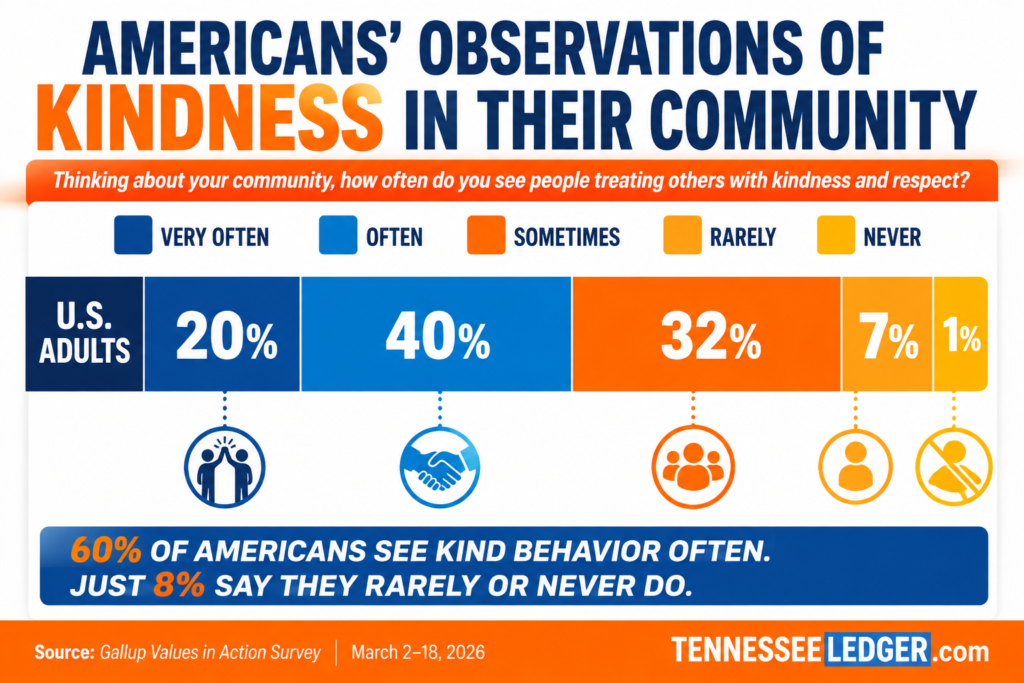
Americans commonly see others acting kind or respectful toward others. Six in 10 U.S. adults say they see people treating others with kindness and respect either “very often” (20%) or “often” (40%), while 32% “sometimes” see kind behavior and just 8% say they “rarely” or “never” do.