Tennessee Lawmakers Move to Strengthen Congressional Representation
Following Supreme Court Ruling
In the wake of a landmark Supreme Court decision, Tennessee lawmakers are seizing the opportunity to bring the state’s congressional map into full constitutional compliance — and potentially deliver more balanced representation for all Tennesseans, including those in Memphis and Shelby County.
A Court-Cleared Path Forward
On April 29, 2026, the United States Supreme Court issued its ruling in Louisiana v. Callais, finding that race-based congressional districts violate the Fifteenth Amendment. The decision gave state legislatures across the South the legal clarity they needed to replace outdated, race-conscious maps with districts drawn on legitimate partisan and geographic grounds.
Tennessee’s 9th congressional district — the state’s only majority-minority district and its sole Democratic seat — drew immediate scrutiny following the ruling. Governor Bill Lee responded swiftly and responsibly, calling a special session beginning May 5 to ensure Tennessee’s map reflects both constitutional standards and the will of its voters.
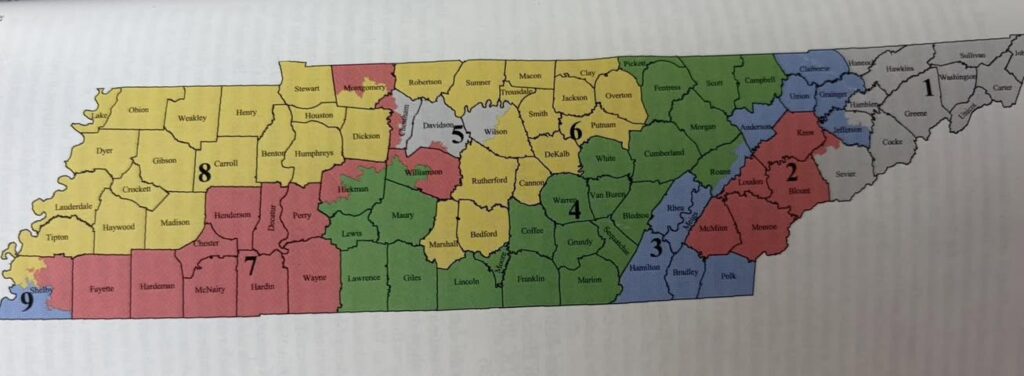
2002 Congressional map drawn by democrats, notice the 7th congressional district map runs from Shelby County to Montgomery County, thus from Mississippi border to Kentucky border
Republican Leaders Rally Behind Reform
Support for the new map came quickly from Tennessee’s federal delegation. U.S. Senator Marsha Blackburn voiced her backing, emphasizing the importance of maps that advance a strong legislative agenda for the state. U.S. Representative John Rose argued that Memphis residents deserve representation that reflects the broader political landscape of Tennessee — a state that has trended decisively Republican for over a decade.
President Trump personally engaged with Governor Lee, later noting that Lee would work to correct what Trump characterized as constitutional flaws in the existing map. House Speaker Cameron Sexton echoed the Supreme Court’s own logic, noting that the ruling explicitly permits states to redistrict on the basis of partisan politics.
A Map Built on Geography, Not Race
The proposed map, unveiled May 6, divides Memphis and Shelby County among the 5th, 8th, and 9th congressional districts. Supporters argue this approach integrates Memphis voters into broader regional districts, giving them a meaningful voice in multiple congressional conversations rather than concentrating and isolating their influence in a single seat.
To clear the path for the redraw, Speaker Sexton filed legislation removing a state law provision that had barred mid-decade redistricting — a procedural step supporters say is entirely appropriate given the extraordinary legal circumstances created by the Supreme Court’s decision.
Democrats Push Back
Democratic leaders have vocally opposed the effort, holding press conferences near the National Civil Rights Museum and characterizing the redraw as racially motivated. State Representative Justin Pearson launched a “Defend District 9” campaign, and hundreds of protesters gathered at the State Capitol on the first day of the special session.
Republicans, however, maintain that the new maps are constitutionally grounded — and that the Supreme Court itself has signaled that racial set-asides in redistricting are no longer permissible under the law.
With primary elections scheduled for August 6, 2026, the legislature is moving quickly to give candidates and voters the certainty they need heading into a critical election cycle.