Tennessee politics has never been short on drama — but what is unfolding right now around the newly redrawn 9th Congressional District may be the most consequential political story in this state in a generation. Republicans in the Tennessee General Assembly did what Democrats have done for decades — they redrew the map.
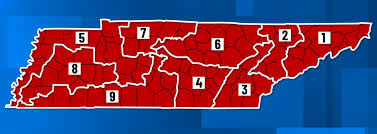
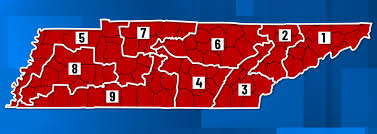
Newly created district 9 congressional map with three seats for Memphis
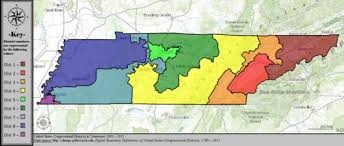
In 2002 Democrats redrew congressional lines to consolidate political power, and Republicans have now responded in kind, this time breaking Memphis into three separate congressional districts and giving that city — which has earned the painful distinction of being one of the top cities in America for violent crime — three separate voices in Washington instead of one. Whether you agree with the method or not, the move was legal, it was constitutional, and it was political — just as it has always been in American democracy.
2002 congressional map that democrats created showing three congressional districts
In a matter of days, Governor Bill Lee called a special session, the Tennessee General Assembly changed state law, redrew the lines, and ignited a firestorm of lawsuits, protests, and political ambition stretching from the streets of South Memphis all the way to the suburbs of Rutherford County. The new map passed both chambers on May 7 and Lee signed it into law the same day. Now the new 9th District runs from south Memphis across the southern part of Tennessee before turning north into Marshall, Maury, Williamson and Rutherford counties — more than 200 miles of new political territory that will help define congressional representation in Tennessee for years to come.
There is wisdom in what is happening here that goes beyond the politics. Scripture reminds us in Ecclesiastes 4:12 that “a cord of three strands is not easily broken.” Three congressional voices for Memphis — if those representatives choose to work together for their constituents rather than for their own ambitions — could ultimately serve that city far better than one solitary voice ever did. The question is whether Memphis will seize the opportunity or spend the next decade fighting the map in court while crime continues to claim lives on its streets.
Three lawsuits are already in federal court. Two Republicans have jumped into the race. And the people of Middle Tennessee — including right here in Rutherford County, specifically parts of Smyrna and La Vergne — are now part of a district that will help define the future of our state. This is the story of how we got here and what comes next.
Candidates running for Tennessee’s 9th District:
Tennessee’s 9th District now spans 10 counties eastward along the southern border of the state, all the way to parts of Williamson County near Nashville.
Candidate
Party
Location
Status
Charlotte Bergmann
Republican
Memphis
Qualified*
Arthur Gibson
Republican
Memphis
Petition Issued
Brent Taylor
Republican
Eads
Signatures Approved
Jeremy Thompson
Republican
Fayetteville
Signatures Approved
Todd Warner
Republican
Lewisburg
Signatures Approved
M. LaTroy A-Williams
Democratic
Memphis
Qualified*
Steve Cohen
Democratic
Memphis
Qualified*
Jeannie Michelle Head
Democratic
Lewisburg
Petition Issued
London Lamar
Democratic
Memphis
Petition Issued
Justin J. Pearson
Democratic
Memphis
Qualified*
Michael Sanford
Democratic
Memphis
Petition Issued
Jim Torino
Democratic
Columbia
Qualified*
Brenda Woods
Democratic
Bolivar
Petition Issued
Dennis Clark
Independent
Memphis
Qualified*
Arthur Gibson
Republican
Memphis
Petition Issued
Trevor Murphy
Independent
Franklin
Petition Issued
Notes from the Tenn. Secretary of State: *Candidates who previously qualified for the 2026 congressional election may continue to seek office in a newly drawn district if it retains the same district number.
How the Map Changed
In April 2026, Tennessee lawmakers began considering a mid-decade redistricting plan ahead of the 2026 House elections. The push came after the United States Supreme Court ruled in Louisiana v. Callais that Louisiana’s redistricting map was an unconstitutional racial gerrymander under the Fifteenth Amendment. Following that ruling, Tennessee Republicans moved quickly.
On May 1, Governor Lee called a special session beginning May 5 to review the state’s congressional map. Republicans argued the redistricting was done for political purposes — to give President Trump another vote in Congress — and not based on race. Democrats called it a power grab. The protests that followed inside the Capitol walls were, in my 26 years of public service, some of the most disgraceful behavior I have ever personally witnessed — but that is a story for another column.
The new 9th District starts in Memphis, meanders across rural southern Tennessee, and ends more than 200 miles away in suburban Williamson County south of Nashville. That means communities from Shelby County to Marshall County to Maury County to Williamson County — and portions of Middle Tennessee including areas near Smyrna — are now represented under one congressional district. Voters in these communities deserve to know who is asking for their vote.
The Republican Primary
Two Republicans have entered the race for the
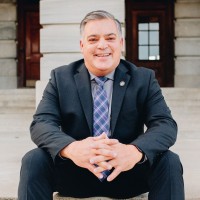
Rep. Todd Warner—Chapel Hill (R)
new 9th District, and they could not be more different in background.
Rep. Todd Warner — Marshall County
Republican Rep. Todd Warner of Chapel Hill in rural Marshall County announced he will run for the 9th U.S. Congressional District. Warner is a farmer and state legislator who makes no apologies for where he stands.
“I’m not a politician picked by insiders, consultants and lobbyists,” Warner said in his announcement statement. “I’m a Tennessee fighter who will never back down, never surrender, and never apologize for putting Tennessee first. The swamp can keep their endorsements. I’m running for the people who feel like nobody in Washington fights for them anymore.”
Warner wore a Trump flag on the House floor during the redistricting vote last week — a visual statement that left little doubt about where his loyalties lie.
Sen. Brent Taylor — Shelby County
Republican Sen. Brent Taylor of Eads in Shelby County announced his candidacy the same day the legislature adopted
Sen. Brent Taylor-Memphis (R)
the map and Governor Lee signed it into law. Taylor is a former funeral home operator and a veteran of Memphis and Shelby County politics, having previously served on the Memphis City Council and the Shelby County Commission.
“We are at a defining moment in Tennessee’s history and an even more pivotal moment for the future of our country,” Taylor said in a Facebook post, adding that he is running to “stand with Trump and cement Tennessee’s conservative legacy for generations to come.”
Taylor has a substantial legislative record. He pushed through an English-only driver’s license test as part of Tennessee’s immigration package, championed state oversight of Memphis Shelby County Schools with the creation of a state oversight board, supported a forensic audit of the school district’s finances, and has been an outspoken critic of Shelby County District Attorney Steve Mulroy — passing legislation giving the state the ability to investigate his office.
The Republican primary is set for August 6, 2026.
The Democratic Primary
The Democratic side is crowded and contentious, featuring an incumbent fighting for his political survival against a high-profile challenger.
Rep. Steve Cohen — Incumbent
Steve Cohen has represented Tennessee’s 9th District since January 2007 and is one of the longest-serving members of Tennessee’s congressional delegation. A Vanderbilt University and Memphis State University law school graduate, Cohen has built his career in Memphis politics spanning decades. He has made clear he intends to fight — both in court and at the ballot box — for his seat.
Rep. Justin Pearson — Memphis
State Representative Justin Pearson of the 86th district is leaving his House seat to run for the 9th Congressional District. Pearson has become one of the most polarizing figures in Tennessee politics. He rose to national prominence after being expelled from — and then reinstated to — the Tennessee House. He has continued to generate controversy inside the Capitol, including incidents I witnessed personally during the redistricting special session that I have documented separately in these pages.
M. LaTroy A-Williams — Community Activist
M. LaTroy A-Williams, a community activist, is also running in the Democratic primary. Williams has run for this seat before and brings a grassroots community organizing background to the race.
DeVante Hill
DeVante Hill has also entered the Democratic primary field for the newly redrawn 9th District, adding to what is shaping up to be a crowded and competitive Democratic contest.
The Democratic primary is also set for August 6, 2026.
The Independent
Wendell Blankenship
Wendell Blankenship is running as an Independent in the general election for Tennessee’s 9th Congressional District on November 3, 2026. Blankenship has run in this district before and represents an alternative for voters who feel neither party speaks for them.
What Happens Next
A federal court hearing is set for May 20 to determine whether a temporary restraining order should be placed on Tennessee’s new congressional district maps — just days after the new candidate qualifying deadline. The legal fights could reshape the race before a single vote is cast in August.
What is not in dispute is that this new district — stretching from the streets of Memphis to the farmland of Marshall County to the suburbs of Williamson County — represents a fundamentally different kind of Tennessee. It is urban and rural. It is Black and white. It is conservative and liberal. Whether one representative can truly serve all of those voices is the question every voter in this new district should be asking right now.
Scripture tells us in Ecclesiastes 4:12 that a cord of three strands is not easily broken. Tennessee has given Memphis three congressional strands. What Memphis and Middle Tennessee do with them is now up to the voters.
The primary is August 6, 2026. The general election is November 3, 2026. Pay attention.
Mike Sparks represents Rutherford County in the Tennessee House of Representatives and hosts “Conversations with Mike Sparks,” airing Sundays 5-6pm on WGNS Radio — 100.5 FM, 101.9 FM, 1450 AM or online WGNSradio.com. Tennessee Ledger is a community news publication serving Rutherford County and the state of Tennessee.